







AI is generating more revenue insights than ever, but most teams still struggle to act on them.
The problem is that too many AI outputs are disconnected from the systems, definitions, and buyer context revenue teams actually trust. When recommendations feel opaque or generic, they create hesitation instead of action.
To unpack why AI insights often fail in revenue teams — and what it takes to make them actionable — we spoke with CaliberMind VP of Marketing Nadia Davis. CaliberMind is a go-to-market (GTM) intelligence and revenue analytics platform built for enterprise teams, designed to unify buyer signals across marketing and sales systems and provide a governed data foundation that AI can reliably build on.
“Teams can't trust AI outputs when the underlying data isn't unified or modeled prior to being fed into an AI tool - or when AI output is based on probability and not rooted in the actual business rules,” Davis says.
That’s why the next phase of revenue AI isn’t more automation — it’s deterministic AI: AI built on governed data, unified buyer signals, and logic teams can actually use in decisions.
- Why AI insights fail in revenue organizations
- What deterministic AI means for revenue teams
- AI that drives action vs. AI that creates noise
- How Agent Cal from CaliberMind puts deterministic AI into practice
- Enterprise AI use cases tied to revenue outcomes
- From AI insight to revenue action
- How to scale AI without losing trust
- Frequently Asked Questions (FAQs)
- Bottom line
Why AI insights fail in revenue organizations
AI promises clarity, but often creates confusion. The breakdown typically happens in three areas:
- Too many signals, not enough prioritization: Revenue teams already manage web activity, intent data, CRM updates, and engagement signals. AI often adds another layer without helping teams focus on what matters most.
- Black-box output and lack of transparency behind metrics undermine trust in data: Teams hesitate to act on outputs they don’t understand. A “high-priority account” label means little without context.
- Unexplainable insights don’t change behavior: Insights only matter when they influence action. If a recommendation can’t be tied to real activity, teams ignore it.
“When AI insights are interesting but not useful and have no contextual relevance - such as being tied to specific actions along the buyer's journey - they become noise,” Davis says.
This hesitation reflects a broader trend: most organizations are still in the experimentation phase of AI. Nearly two-thirds report they have not yet begun scaling AI across the enterprise, according to McKinsey. This helps explain why many insights fail to translate into action.
What deterministic AI means for revenue teams
Deterministic AI is not about replacing human judgment with predictions; it’s about enabling better decisions by grounding AI outputs in governed data, consistent definitions, and transparent logic. In revenue operations, this means every AI-driven insight can be traced, validated, and tied back to the business logic teams already use.
- Governed inputs and consistent definitions: Deterministic AI relies on standardized inputs aligned with established business rules and data taxonomies. When definitions are consistent across systems, AI outputs become reliable and repeatable, not conflicting or ambiguous.
- Unified attribution and buyer signals: Deterministic AI operates on existing business definitions across all GTM metrics and a complete, connected view of the buyer journey across marketing and sales, ensuring recommendations reflect real engagement patterns, not isolated signals.
- Explainability as a requirement: Every recommendation must be transparent and traceable. Teams should be able to drill into AI outputs to see how a number was calculated, which signals and data sources contributed to it, and what logic shaped the result.
Instead of automating decisions, deterministic AI supports them. It provides explainability and transparency behind agentic analytics outputs, giving revenue teams the clarity and confidence to act on insights they understand and trust.
“Most AI today is a ‘black box.’ You get a number, but you don’t know how the machine got there. We built Agent Cal to be the first agentic analytics solution that shows its work, giving leaders the confidence to make million-dollar decisions.”
AI that drives action vs. AI that creates noise
Even with the right data foundation in place, not all AI outputs are equally useful. The real distinction between AI that drives action and AI that creates noise is its usability.
AI that drives action | AI that creates noise |
Tied to specific accounts, signals, and timing | Generic alerts without context |
Explains what happened and why | Opaque outputs with no explanation |
Recommends clear, logical next steps | Leaves teams unsure how to act |
Directly connects to pipeline and revenue outcomes | Disconnected from business impact |
Built on governed, compliant data | Raises data trust and compliance concerns |
If an insight doesn’t change what your team does next, it isn’t adding value.
How Agent Cal from CaliberMind puts deterministic AI into practice
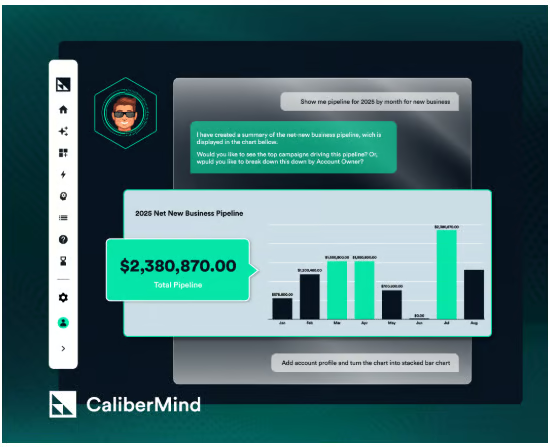
This is where CaliberMind's Agent Cal — the platform's conversational AI agent — makes the concept of deterministic AI tangible for revenue teams.
Agent Cal is built directly on CaliberMind's governed data foundation: unified attribution, buyer journey signals, and pipeline data. Instead of producing generic summaries or opaque scores, it lets
teams ask natural-language questions and get answers that are traceable back to the exact signals, touchpoints, and logic behind them.
For example, a demand gen leader can ask, "Which campaigns are driving the most marketing-qualified pipeline this quarter?" and get an answer grounded in real attribution data — not a probabilistic guess. A sales leader can ask, "Which accounts in my territory are showing the most engagement momentum?" and see exactly which contacts engaged, what content they interacted with, and why the account is surfacing now.
This matters because the deterministic AI principles outlined above — governed inputs, unified signals, and explainability — are only valuable when they're embedded in a tool teams actually use. Agent Cal operationalizes those principles inside the workflows where decisions happen.
Enterprise AI use cases tied to revenue outcomes
When grounded in trusted, unified data, AI becomes practical. Platforms built on unified, governed data can provide this foundation, connecting attribution, engagement, and pipeline data so AI outputs reflect what actually drives revenue. CaliberMind is one example of a platform designed to support this approach.
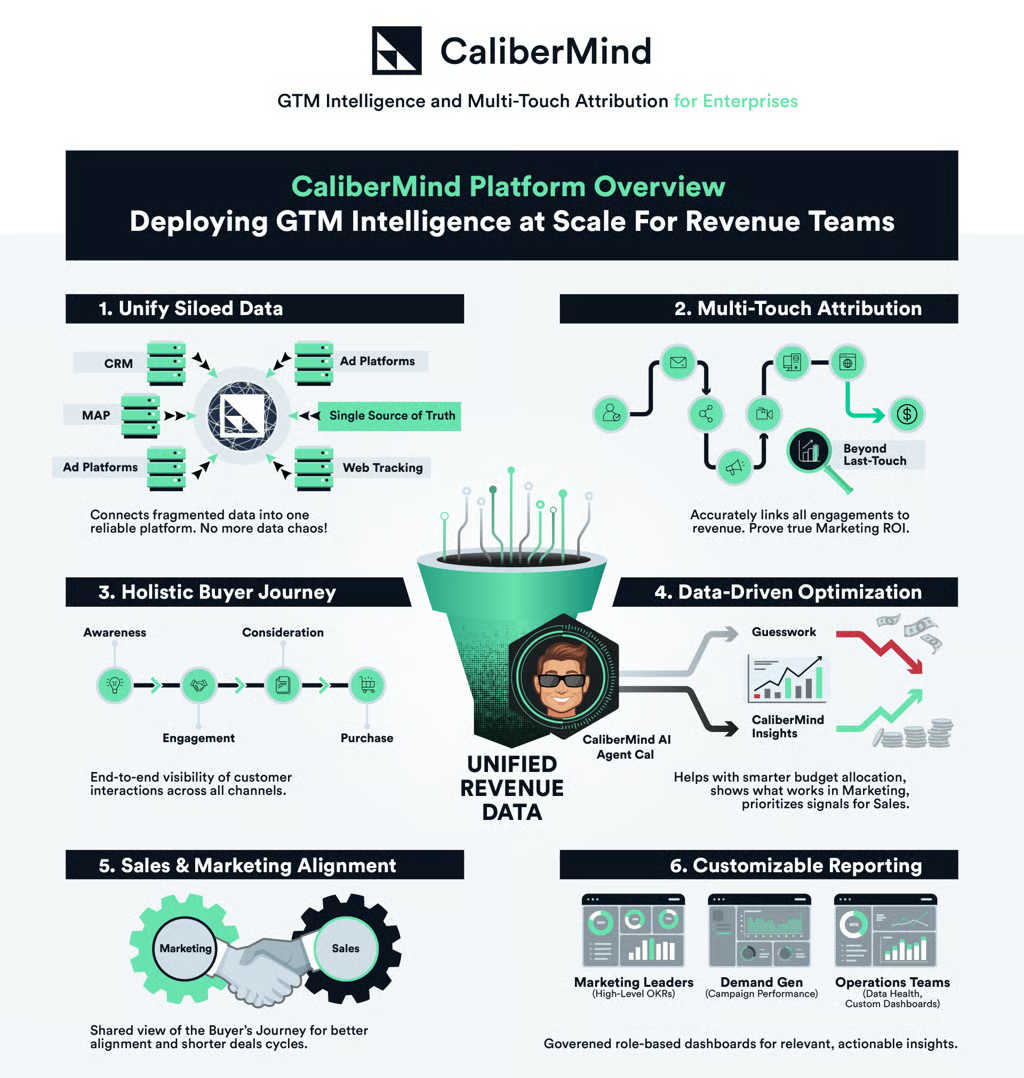
- Account prioritization using trusted signals: AI can rank accounts based on meaningful engagement patterns across the buying group, helping teams focus on where momentum is building.
- Pipeline risk and stall detection: AI can help surface deals losing momentum based on gaps in engagement, delayed follow-up, or missing stakeholders before issues surface in forecasts.
- Channel and program optimization: AI can identify which programs correlate with pipeline progression, enabling smarter budget allocation.
- Sales-ready account insights: AI can surface actionable context at scale by account segment, region, or product category — who engaged, what they engaged with, and why the account matters now — so sales can act immediately.
- Speed to insight: When grounded in consistent pipeline and attribution data, AI enables teams to answer critical GTM questions instantly, without reconciling conflicting reports. For example:
- How are we pacing toward our marketing revenue targets?
- Which campaigns drive strong engagement but high cost?
- Which channels contribute most to marketing-qualified pipeline?
- What are our conversion rates from MQL to pipeline by segment, product, or region?
- Which campaigns generate impressions but fail to drive traffic?
These and many other GTM questions can be answered confidently when AI is grounded in unified, contextualized business data.
- Budget allocation and investment planning: AI can support strategic decision-making by combining attribution with broader modeling approaches, helping organizations evaluate how incremental investments across channels impact long-term revenue outcomes.
From AI insight to revenue action
AI only matters if it drives decisions. Tools like CaliberMind’s Agent Cal are designed to help enterprise revenue teams turn insights into action — surfacing what matters, why it matters, and what to do next. Below are the key ways to operationalize AI insights into revenue impact.
Move beyond summaries to recommendations
Convert signals into clear actions: which accounts to prioritize, who to engage, and what to do next. Agent Cal is designed to do exactly this — surfacing not just data, but specific next steps tied to accounts, contacts, and pipeline context.
Embed AI into RevOps and Sales workflows
Surface insights inside customer relationship management (CRM) systems, pipeline reviews, and campaign planning. If teams have to leave their workflow, they won’t use it. Agent Cal's conversational interface meets teams where they already work, making it easy to pull insights without switching tools or building custom reports.
The impact comes when workflows change — not just dashboards. Organizations seeing the most value from AI are nearly three times more likely to redesign workflows around it.
Measure impact on pipeline movement
Track outcomes, not activity: deal velocity, stage conversion, and revenue impact — business questions answered in seconds with accuracy and audit-grade confidence. Because Agent Cal's outputs are grounded in governed data, teams can validate results and hold AI-driven recommendations to the same standard as their existing reporting.
How to scale AI without losing trust
AI adoption breaks down when governance is missing. CaliberMind helps ensure AI recommendations remain auditable and explainable by grounding them in governed data so teams can scale usage without losing credibility.
To do this effectively, operationalize a few core practices:
1. Make every recommendation traceable
Ensure teams can trace each AI output back to the underlying signals, data sources, and logic.
Example: When an account is flagged as high priority, show the exact engagement, attribution, and pipeline signals driving that recommendation.
2. Control access with role-based visibility
Limit who sees what based on role, so insights stay relevant and manageable.
Example: Give sales visibility into account-level signals and next actions, while RevOps can access full attribution logic and model inputs.
“You do it in a governed access kind of control-minded way, giving people what they need when they need it,” Davis explains.
3. Validate outputs against real outcomes
Regularly compare AI recommendations to actual pipeline results and adjust models accordingly.
Example: Track whether AI-prioritized accounts convert faster or at higher rates, and refine thresholds based on performance.
Frequently Asked Questions (FAQs)
What is deterministic AI in B2B revenue operations?
Deterministic AI in B2B revenue operations refers to AI systems built on governed, structured data that produce explainable, consistent, and repeatable insights. Unlike probabilistic models that generate opaque scores, deterministic AI ties every output to traceable inputs — specific signals, attribution data, and business logic — so teams can validate recommendations before acting on them.
How does deterministic AI differ from predictive scoring?
Predictive scoring typically uses machine learning to assign a likelihood score without revealing the reasoning behind it. Deterministic AI, by contrast, grounds every recommendation in transparent logic and governed data. Teams can drill into the underlying signals and attribution to understand why an account or lead is being prioritized, not just that it was.
Do revenue teams need perfect data to use AI?
No, but they need consistent, governed data. The goal isn't perfection — it's alignment. When teams establish shared definitions, unified data taxonomies, and a single source of truth across marketing and sales systems, AI can produce reliable outputs even if individual data points are imperfect.
How do you trust AI recommendations?
Trust comes from explainability, auditability, and being able to trace output. When teams can see exactly which engagement signals, attribution touchpoints, and pipeline data contributed to a recommendation — and can validate those against real outcomes — they're far more likely to act on AI insights with confidence.
What are the risks of AI in revenue decisions?
The biggest risks are acting on opaque insights that can't be validated, scaling AI without governance frameworks in place, and building AI on fragmented or inconsistent data. These risks lead to misaligned priorities, eroded trust between teams, and decisions that don't hold up under scrutiny.
Bottom line
AI only becomes valuable when it drives action, not just insight. With tools like CaliberMind, revenue teams can turn governed data and unified signals into clear next steps they can trust.
Deterministic AI bridges the gap between insight and execution. This way, enterprise revenue teams don’t just see more; they prioritize better, act faster, and drive measurable pipeline impact.
Discover what CaliberMind can do for your GTM team
