The forecast tug-of-war no one talks about |
Every year around this time, sales and marketing hit the same wall, with one foot on the gas and the other on next quarter’s plan.
Sales is sprinting to close every deal before year-end, while marketing is pushing out final campaigns and getting a head start on next year’s content, positioning, and pipeline goals. Everyone is stretched, and somehow both teams are expected to execute flawlessly while also planning strategically. |
|
|
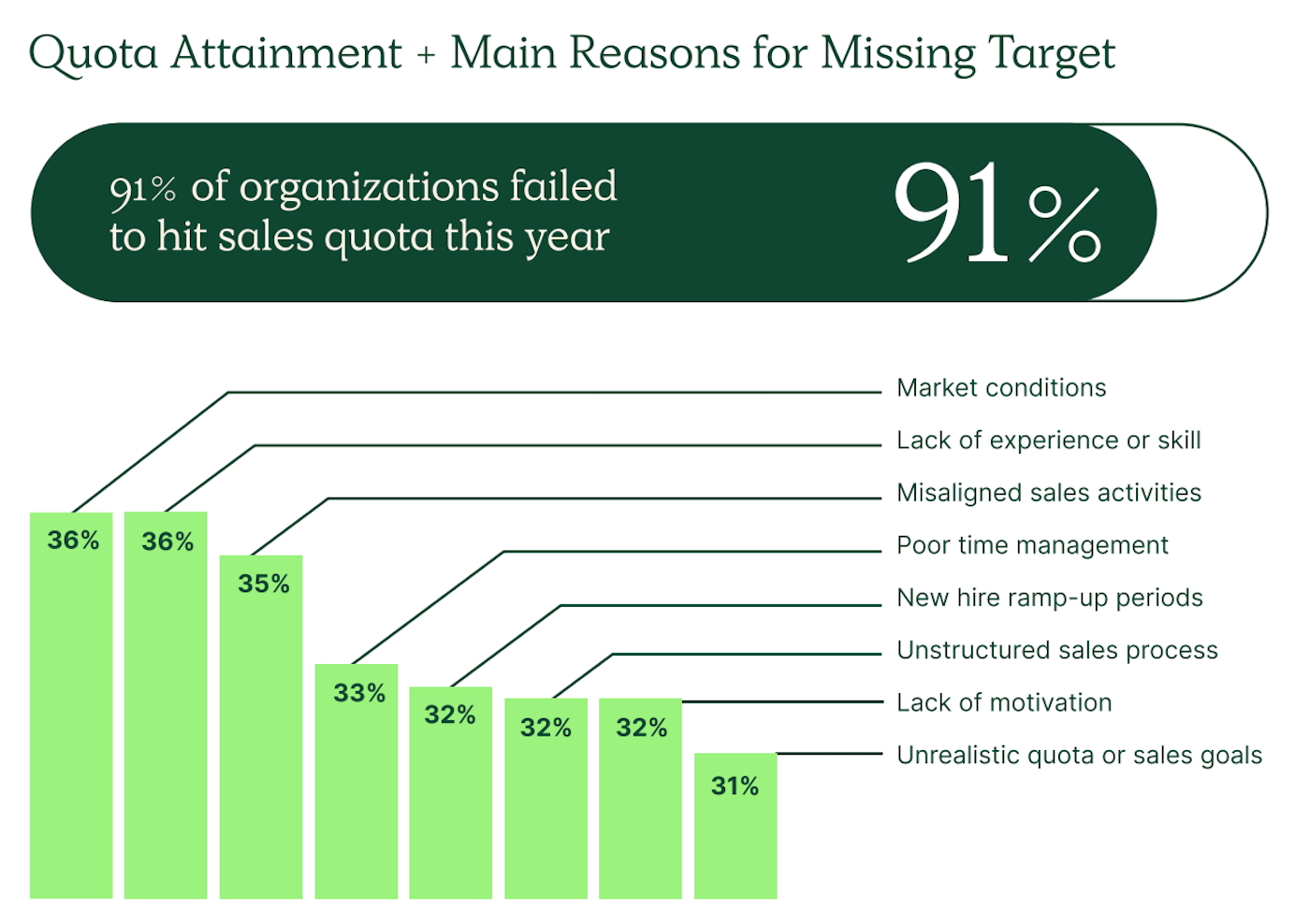
Market conditions and a lack of experience are the top reasons why most organizations failed to meet their sales quotas this year. (Source: QuotaPath) |
The tension isn’t the real issue. The misalignment is. Forecasts break down when sales and marketing operate on different rhythms, data, and definitions of truth.
This week, we’re digging into how to forecast realistically in the chaos. Let’s discuss how to close the year strong without sacrificing next year’s plan, and how alignment can turn forecasting from a pressure cooker into a real strategic advantage. |
|
|
Forecast like an adult, sell like it’s December 31 |
Forecasting feels chaotic when your pipeline is padded, and you’re just quietly hoping that December delivers a miracle. But the real problem isn’t effort; it’s alignment.
Deloitte’s latest sales research found that only 10% of companies have fully optimized RevOps across all GTM functions with centralized planning.
This means most teams are forecasting with fragmented data, mismatched assumptions, and zero shared visibility. Add to that QuotaPath’s finding that 24% of companies miss quota due to poor plan design, and forecasting accuracy drops even further.
So yes, year-end pressure is real. But forecasting doesn’t have to be a panic ritual. With clearer communication and cleaner inputs, you can close strong and set up an accurate plan for Q1. Here’s how to stay sane and strategic in the crunch: |
-
Be brutally honest about late-stage deals. If the buyer has ghosted or momentum is dead, remove it from the forecast before it bites you.
- Give marketing the real story. Share the objections, stalls, and patterns happening in your calls so they can reinforce deals with targeted content.
-
Ask for fast deal support. A timely one-pager, proof point, or case study can revive a slipping opportunity better than another “bumping this up” email.
- Seed Q1 pipeline now. Add light, low-pressure touches to early-stage accounts so January doesn’t start at zero.
- Clean your CRM like revenue depends on it. Because it does. Wrong stages and mystery notes destroy forecasting accuracy.
- Make the next steps painfully clear. Every deal needs a concrete action you can track, not a hopeful “follow up soon.”
|
Build next year’s plan from aligned sales and marketing data to turn forecasting into a real strategic advantage for your team. |
|
|
Stop marketing for the forecast you wish you had |
If forecasting season turns sales into optimists, it turns marketing into full-time firefighters. Deals stall, gaps magically appear in the pipeline, and suddenly every request becomes urgent.
“Can you launch a campaign next week?” “Do we have content for this persona?” “Can you generate more pipeline… like, today?”
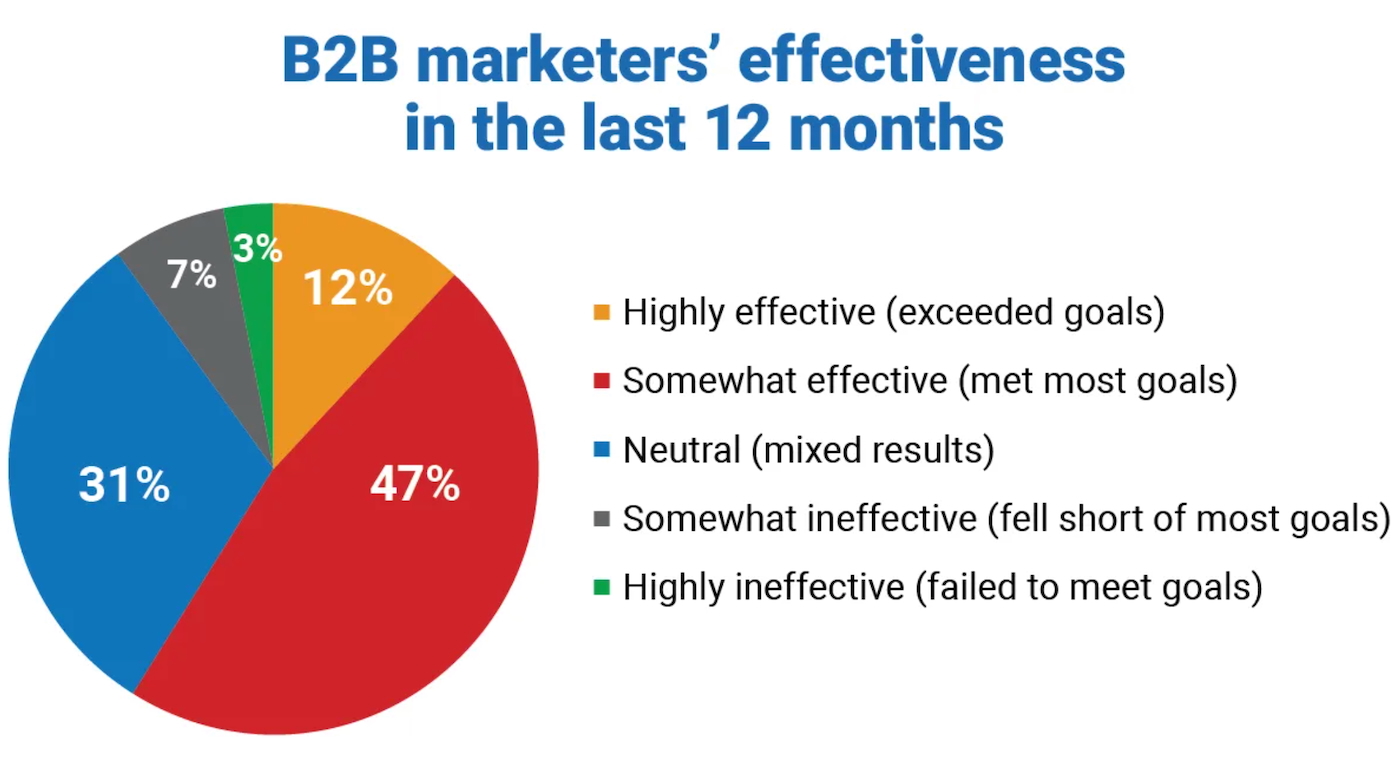
So it is no surprise that in the latest Content Marketing Institute report, only 12% of marketers said they were highly effective. Meanwhile, 47% said they were merely “somewhat effective” over the last 12 months. Translation: Most marketers are doing their best while the house is kind of on fire.
|
Only 12% of B2B marketers say they were highly effective in the last 12 months. (Source: Content Marketing Institute) |
The problem here is the timing. Marketing is expected to rescue the quarter while simultaneously building next year’s master plan, but without a real view into what is actually happening in the pipeline. |
Here’s how marketing can bring clarity (and a little sanity) to the chaos: |
- Anchor campaigns to real buyer signals. Use intent data, engagement trends, and sales feedback to prioritize audiences that are actually moving.
-
Ask sales for the top three stall points. Build fast-turn messaging or assets that unblock deals instead of guessing.
- Create Q1-ready assets now. Build case studies, nurture flows, and messaging frameworks while everyone else is in holiday mode.
- Run a forecasting sync, not a handoff. Align on ICP, deal stages, and what “healthy pipeline” really means — no more blind spots.
- Minimize noise, maximize impact. Double down on the handful of activities that actually move revenue, not everything that sounds urgent.
|
Marketing’s real power during the forecasting season is knowing exactly where to put energy, not merely producing more. When you align with sales on the real risks, buyer behavior, and key signals, you gain the power to steer the forecast instead of merely chasing it. |
|
|
Marketing: “The forecast shows rising intent based on engagement trends.”
Sales: “The forecast shows my champion just went on PTO until January.” Marketing (in Slack): “We planned a December content push to help you close.”
Sales (in a huddle): “I love that for you, but no buyer reads a whitepaper on December 18.”
Sales on Reddit: “Why does marketing keep asking for ‘updated deal notes’ when I’m drowning in closing tasks?”
Marketing on Reddit: “Why does sales only update the CRM after the deal closes… or dies?” |
→ Translation: End-of-year forecasting turns every signal into noise because marketing is judging momentum while sales is fighting the calendar.
The only way to stop the wires from crossing is to align on real-time truth: what deals are actually moving, what buyers are actually saying, and what support will actually matter in the final stretch. |
|
|
Forecasting should be treated as a dynamic, ongoing process, not a static spreadsheet exercise.
To achieve reliable forecasts, align sales' real-world pipeline signals with marketing's broader demand insights. Focus the shared forecasting view on buyer-stage progression rather than internal stages. Finally, incorporate real-time market feedback to temper historical trends. By doing this, both sales and marketing can move beyond merely reacting to unforeseen events and collaboratively increase revenue. |
|
|
|
Bianca has spent the past four years helping businesses strengthen relationships and boost performance through strategic sales and customer engagement initiatives. Drawing on her experience in field sales and territory management, she transforms real-world expertise into actionable insights that drive growth and foster lasting client partnerships. |
|
|
Selling Signals is a TechnologyAdvice business © 2025 TechnologyAdvice, LLC. All rights reserved. TechnologyAdvice, 3343 Perimeter Hill Dr., Suite 215, Nashville, TN 37211, USA. |
|
|
|