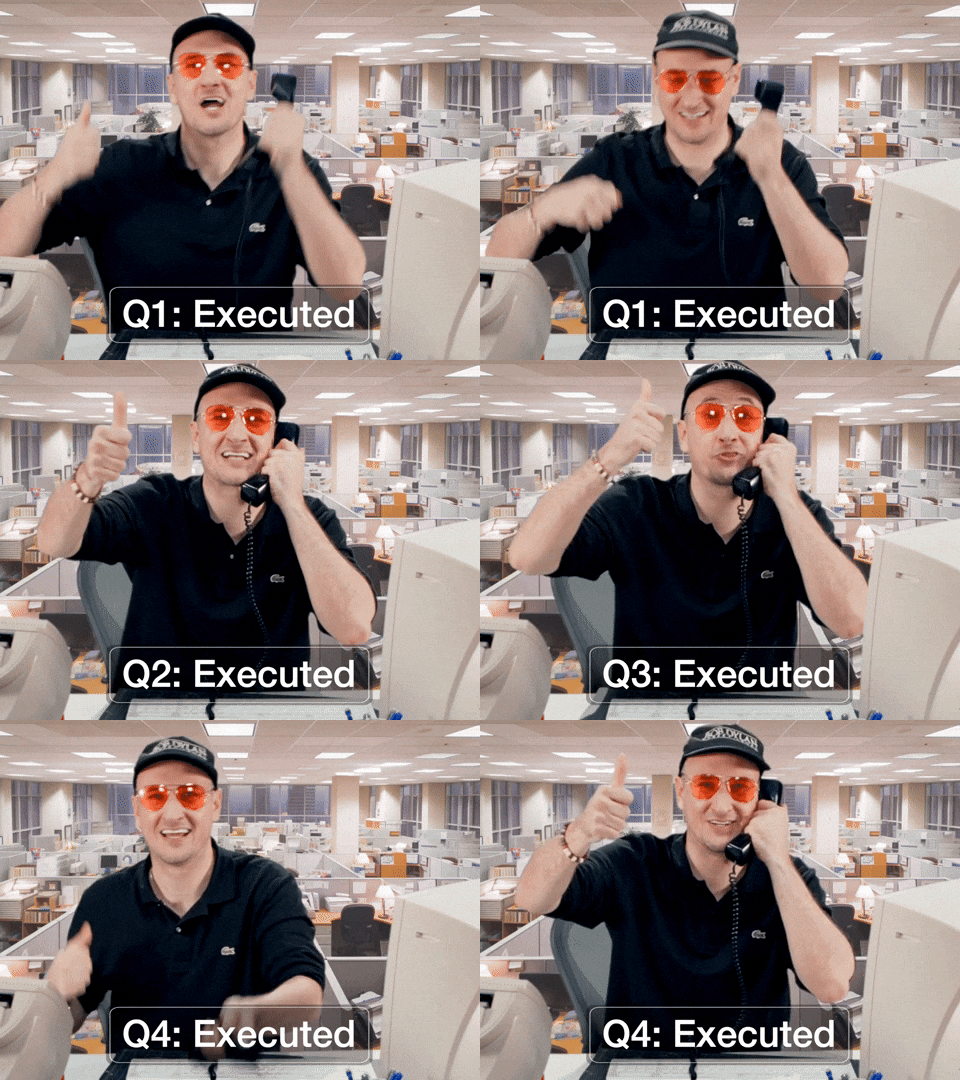
If you’re still finalizing your Q1 plan… you’re not alone. |
Every year, like clockwork, a quiet group emerges around this time: the “last-minute crew.” The reps still logging December calls. The marketers juggling year-end reporting and holiday campaigns. The managers still trying to find that one spreadsheet they swear they created last year.
|
|
|
When Q4 starts feeling like The Bear Season 4, lock in and let the countdown begin! |
The good news? Being behind doesn’t mean being unprepared. It just means your planning needs to be practical, achievable, and focused on what you can control heading into Q1. And honestly, sometimes late planners build better plans because they cut the fluff and get straight to what actually drives results.
But we can’t circle back forever, so today’s newsletter is your shortcut: simple forecasting steps you can still complete this month, easy templates you can borrow (including two I wrote just for you), and fast ways to turn December chaos into January clarity.
Let’s get your Q1 plan in place so that “I’ll start tomorrow” doesn’t turn into “I wish I’d started earlier.” |
|
|
Build a Q1 forecast that works (even if you’re behind) |
Forecasting doesn’t need to be complicated. In fact, the best Q1 forecasts are built from clear inputs, not perfect data. If you’re running behind, here’s how to get a functional and accurate forecast in place before the new year kicks off. |
1. Start with pipeline health, not a guess
Before you lock in a Q1 forecast, run a simple pipeline analysis. Look at how many opportunities you have, your average deal size, win rate, and sales cycle length as key inputs to understand pipeline velocity and to forecast more accurately.
Once you see how fast deals are actually moving through each stage (and where they stall), your Q1 data becomes a reality check, not a wish list. |
2. Set ‘confidence tiers’ instead of a single forecast
In addition to forecast categories, create a conservative forecast (what’s most likely), a target forecast (your stretch goal), and an upside forecast (your best-case scenario). This gives leadership visibility while giving reps flexibility, which is especially helpful for teams running behind on planning. |
3. Align Q1 expectations to your actual sales cycle If your average cycle is 60 days, January activity influences March revenue. Too many teams forecast the quarter without considering the time constraint.
Work backward from your cycle length, or use rolling-quarter analyses, to determine how much pipeline you really need to generate in early Q1. |
4. Use templates to speed up the grunt work If you don’t want to build a forecast from scratch, I wrote a set of customizable templates just for this: |
At the end of the year, the real goal isn’t creating the perfect forecast. It’s creating a plan that tells you exactly where to start in January and how to stay ahead of the curve after that. |
|
|
📈 Growth amid uncertainty: Jump-starting B2B sales performance - McKinsey looks at how leading B2B companies are still outgrowing their markets, even in volatile conditions, by focusing on a handful of “acceleration levers” like smarter targeting, data-driven personalization, and tighter pipeline discipline. It’s a good read if you’re trying to set ambitious but realistic Q1 goals in an unpredictable environment.
🔮 Navigating 2026: Key predictions for B2B leaders - This forward-looking report highlights key 2026 predictions for B2B marketing, sales, and product leaders, including how AI, shifting buyer expectations, and budget scrutiny will shape go-to-market strategies. It’s a useful backdrop as you think beyond Q1 and into next year’s bigger picture.
🎧 Our simple 3-step B2B demand generation strategy for 2026 - This B2B Playbook podcast episode walks through a three-step demand gen framework for 2026, focusing on how to build campaigns that support pipeline, not just impressions. It’s a deeper dive, but a solid listen if you’re rethinking how marketing and sales should work together to generate demand next year.
|
|
|
A Q1 plan that won’t fall apart in February |
Marketers often get pulled into Q1 planning late because December is overloaded with reporting, campaign wrap-ups, and budget conversations. If you’re still building your plan, here’s how to make sure it’s both realistic and effective. |
- Choose three priorities, not 12
The fastest way to ruin a Q1 plan is to make it too big. Pick the initiatives that will meaningfully impact pipeline, brand trust, or outbound support. Everything else can wait until Q2.
- Anchor your strategy to sales cycles
Planning in isolation turns into wasted content. Work backward from sales’ timelines, so your Q1 campaigns line up with when reps need fresh assets, not when your content calendar says they should launch.
- Build your calendar around buyer behavior, not just internal deadlines
January is a time for planning and research. February is comparison mode. March is decision mode. If you’re behind, focus on early-funnel educational content to meet buyers right where they’re starting their process.
- Use templates to accelerate planning
If you need a fast way to map your content and social strategy for Q1, I wrote another resource that can help:
|
At this stage in the game, being “behind” doesn’t mean being ineffective. Late planners just need tighter priorities, clearer alignment, and tools that reduce lift so they can hit the ground running in January. |
|
|
📅 Understanding seasonal ad revenue - This article digs into how ad revenue fluctuates through the year and why seasonality matters more than you think. Great for marketers planning Q1 because it helps you understand when revenue dips are naturally expected and when to expect a rebound.
🏝️ Q5 is not a break: How to prepare your marketing strategy for Q1 growth - A practical guide for marketers who treat the post-holiday stretch (Q5: late December to mid-January) not as downtime, but as an opportunity. It covers how to audit campaigns, reorganize budgets, and lay the groundwork for Q1 before the rush hits. Smart play if you’re starting late or want to get ahead.
🎩 The magic of seasonal B2B marketing: Your Q1 guide to budget, targeting, & growth - I downloaded this AdRoll report so you don’t have to. This guide offers a detailed, seasonal roadmap for B2B marketers heading into Q1, including how to fine-tune targeting, budget allocation, and messaging to match shifting buyer behavior. |
|
|
When I was putting together my sales forecast templates, I expected people to debate which forecasting method was best. Instead, I discovered that a lot of sales reps don’t believe in forecasting at all, and some see it as a target they’re destined to miss. Take this thread, for example:
From r/sales on Reddit: “Does any org forecast deals accurately? Or is everyone just always pushing stuff from month to month?” And the top comment drives the point home:
“Forecasting is just a tool to pressure sellers… Nobody is a soothsayer and can accurately predict the future.” |
|
|
Translation: Forecasts aren’t predictions; they’re navigation tools. Their accuracy depends on pipeline reality, not wishful thinking. When teams treat forecasts like fortune-telling, they end up disappointed. When they treat them like maps, they end up aligned. |
|
|
|
Faithe has spent more than a decade helping people understand the tools that move business forward. With a Ph.D. in Communication Studies, she breaks down project management, office tech, and social platforms into practical insights for sales and marketing teams. |
|
|
Selling Signals is a TechnologyAdvice business © 2025 TechnologyAdvice, LLC. All rights reserved. TechnologyAdvice, 3343 Perimeter Hill Dr., Suite 215, Nashville, TN 37211, USA. |
|
|
|