AIO was just the beginning |
Last week, MarketingProfs shared a new piece called “Do Marketers Know the Vocabulary of AI Search Optimization?” based on original research from Fractl and Search Engine Land, plus third-party data.
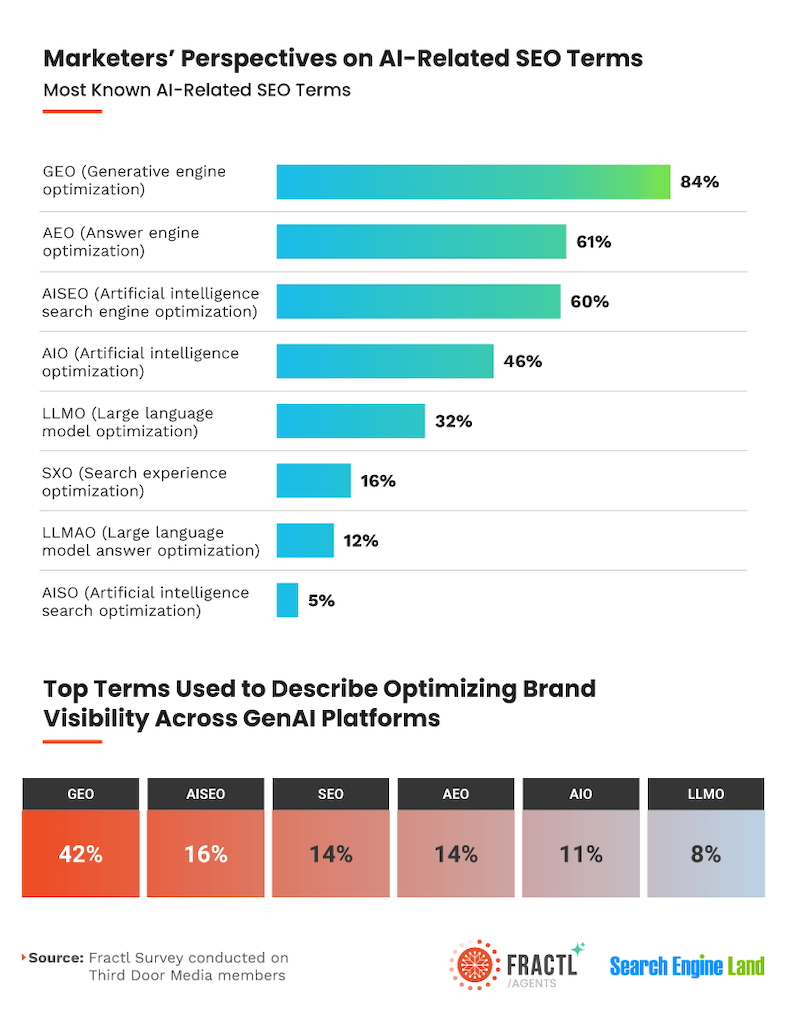
The results are honestly kind of wild. Researchers found that 84% of marketers recognize GEO (generative engine optimization), but only 5% recognize AISO (artificial intelligence search optimization) and other less-common terminology. |
|
|
Data provided by Fractl and SearchEngine Land from Third Door Media Members |
And GEO isn’t even the only term floating around now. We also have AEO, AISEO, AIO, LLMO, SXO, and even LLMAO, which reads like it was invented solely to become a punchline (LMFAO 🤣). |
But this isn’t just marketing jargon for the sake of it. When new technologies emerge, different platforms and vendors compete to define the language, and that language shapes how teams budget, hire, and measure results. So today, we’re decoding the acronyms, dispelling myths about AIO, and translating what all of this means for B2B sales and marketing teams trying to stay visible in 2026. |
|
|
The Sales Take: Visibility is now a shared risk |
Sales teams usually feel the effects of search changes after marketing does, but that gap is shrinking fast. AI-powered discovery is changing what prospects see, what they trust, and what they think they already know before a rep ever reaches out.
Here’s what sales teams can do to stay ahead, without needing to memorize every acronym (but if you want to, check out the Marketing Movement). |
Joe Goldberg wants you to read the Marketing Movement. |
1. Ask prospects where they found you
This sounds basic, but it’s one of the quickest ways to detect AI search behavior. Try: “What did you search?” or “What tool did you use to find us?” in your surveys or sales pitches. If they say “ChatGPT,” “AI overview,” “Perplexity,” or “Copilot,” your visibility strategy just became a sales insight.
2. Treat “search-driven buyers” as already mid-funnel Many prospects now arrive with pre-formed opinions because AI summaries compress your content into a few lines. So, you want to confirm what they think they know before pitching.
Try: “What stood out in your research so far?” and “What options are you comparing?” 3. Feed AI search intel back to marketing weekly
The best sales contribution to SEO in 2026 is not just keywords but context. Share what prospects repeat, what they misunderstand, and what objections sound like AI-generated misconceptions. 4. Create a sales battlecard for your team
AI search often pulls incomplete or outdated information. Work with marketing to create a simple internal sheet or battlecard that clarifies: |
- Your positioning
-
Pricing expectations (if relevant)
- Key differentiators
- Common misconceptions
|
This keeps every rep aligned when buyers show up pre-educated.
🎯Bottom line: You don’t need to become an AI search expert to be effective. You just need to recognize that buyer discovery is now partially automated, and your job is to bring clarity back into the conversation. |
|
|
📩 How to find email addresses for sales prospecting success - Check out our guide to finding verified prospect email addresses without burning hours on dead ends. Written by Bianca Caballero, it includes ethical methods, tools, and tips for improving deliverability so that your outreach actually lands in the right inbox. 🚀 7 forward-thinking sales strategies to embrace in 2026 - A prescient roundup of sales strategies that align with where buyers are headed in 2026, from stronger relationship-building to smarter pipeline management. Useful if you’re planning new-year goals and want quick, realistic tactics to try.
🤖 When AI agents search, do they find your brand and products? - A timely look at what happens when AI agents become the ones doing the searching. This piece from Forbes explains why brand visibility now includes how AI systems interpret your product, summarize your positioning, and decide whether you are worth recommending. |
|
|
The acronym translation guide you actually need |
If you feel like new search acronyms are multiplying overnight, it’s not because you missed a meeting. It’s because everyone is trying to name the same shift from a slightly different angle.
Here’s the simplest way to understand what is happening: SEO is still the foundation, but AI is changing how search engines and platforms interpret content, surface answers, and decide which brands get cited.
And this is not just a trend to watch. It is a structural change in how visibility works. As Nikola Baldikov, SEO specialist and founder of SERPsGrowth, puts it simply: |
|
|
“Search is moving away from blue links, and visibility will depend on how well your content appears in AI-driven answers. Adapting early is the way to go.” (Quote edited for length and clarity.) |
|
|
That shift is exactly why the terminology is exploding. Different platforms, agencies, and tools are all trying to name the same evolution in search, and each term emphasizes a slightly different goal.
So if you find yourself in the next marketing study on AI search vocabulary (or a Slack debate), here’s a cheat sheet. |
AI search acronym cheat sheet |
AEO (Answer Engine Optimization) - Optimizing for direct answers (snippets, voice search, and increasingly AI-driven responses).
GEO (Generative Engine Optimization) - Optimizing for visibility inside generative AI answers and citations, not just rankings.
LLMO (Large Language Model Optimization) - Optimizing for how LLMs interpret, summarize, and attribute your brand across AI assistants.
SXO (Search Experience Optimization) - Optimizing what happens after the click, including page experience, UX, and conversion flow.
AIO/AISEO/AISO - These are umbrella terms. People use them to mean “search optimization in the AI era.” The definitions overlap, which is why confusion is so common.
LLMAO (Large Language Model Answer Optimization) - The emerging practice of making sure your brand shows up in AI-generated answers. Where SEO tries to win the results page, LLMAO tries to win the actual response in tools like ChatGPT, Gemini, and Perplexity. In other words, it is about visibility when there is no longer a “page one.” Your 2026 marketing takeaway: You do not need to pick one acronym. You need to pick one goal. 🎯Are you trying to rank? Get cited? Answer questions? Improve conversion experience? Build brand authority? The acronym follows the strategy.
In other words, stop chasing new vocabulary. Focus on what AI search is actually rewarding: clear positioning, credible sources, structured content, and consistent brand signals across the web. |
|
|
🔍 The AI visibility crisis & 4 trends that can help brands show up - Our breakdown of why visibility is getting harder in the age of AI search, plus four trends marketers can use to stay discoverable. Great if you’re trying to move beyond “SEO panic” and build a visibility strategy that works across AI-generated answers, social, and search. 🧠 AI-generated content isn’t the problem, your strategy is - A sharp, practical reminder that AI content is not inherently harmful. The real problem is publishing without a plan. This piece outlines what actually matters for performance in 2026: intent, structure, differentiation, and quality control.
🌐 Decentralized social media platforms unlock authentic consumer feedback - A research-driven look at decentralized social platforms and why they may produce more authentic audience feedback than traditional networks. Useful for marketers thinking about where “real signals” will come from as algorithms, bots, and paid reach continue to distort engagement.
|
|
|
Marketing: “We need to invest in GEO.”
Sales: “Does that mean more leads?”
Leadership: “Wait, I thought we were doing SEO.”
Vendor: “Actually, you need AIO.” And then there’s Me (imagining this scenario): LMAO |
|
|
→ Translation: These acronyms mostly describe the same shift: buyers are getting answers without clicking, and visibility now depends on how AI systems interpret your brand. Pick the goal first (rank, cite, answer, convert). Then choose the tactics. |
|
|
|
Faithe has spent more than a decade helping people understand the tools that move business forward. With a Ph.D. in Communication Studies, she breaks down project management, office tech, and social platforms into practical insights for sales and marketing teams. |
|
|
Selling Signals is a TechnologyAdvice business © 2026 TechnologyAdvice, LLC. All rights reserved.
TechnologyAdvice, 3343 Perimeter Hill Dr., Suite 215, Nashville, TN 37211, USA. |
|
|
|