Has the influencer boom gone bust? |
Influencer marketing dominated the 2020s.
From TikTok hauls to LinkedIn “thought leaders,” brands rushed to borrow trust from creators with built-in audiences. Entire budgets shifted from traditional ads to personality-driven promotion. |
And yet, scroll any comment section, and you’ll see it:
|
|
|
“Another paid partnership.”
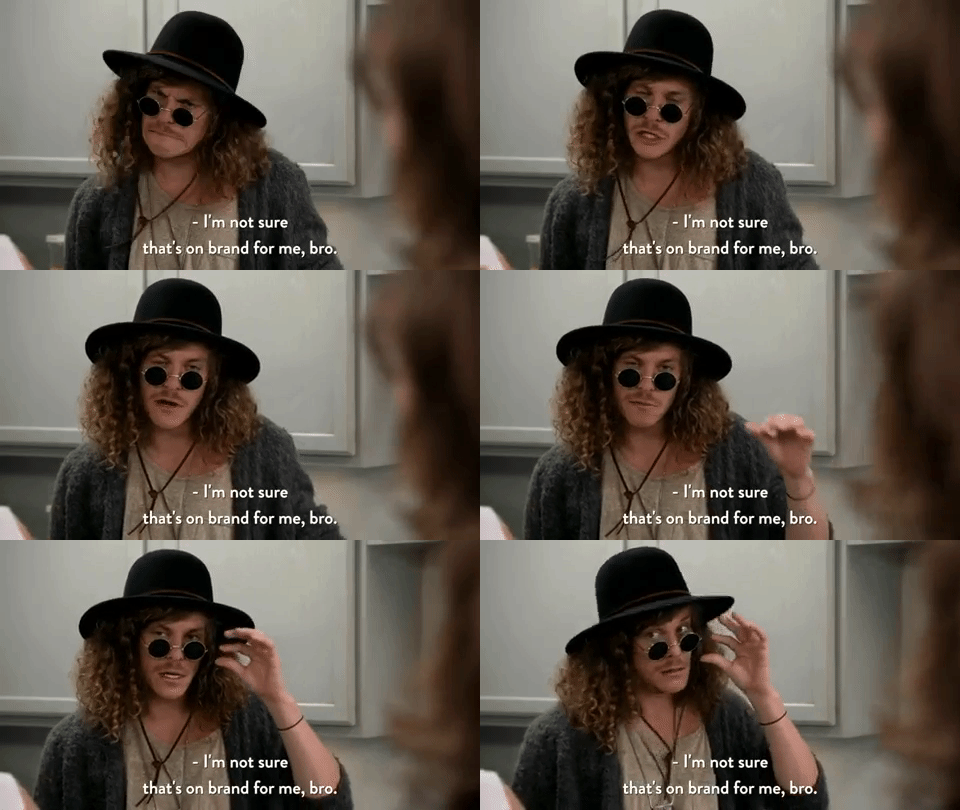
“This doesn’t even sound like you.”
“Deinfluenced.” |
|
|
For the past few weeks, we’ve talked about ad fatigue and generational friction, and the pattern is hard to ignore. Buyers (especially younger consumers) are increasingly skeptical of overt promotions, especially when they feel transactional. So, here’s the question: Is influencer marketing evolving… or eroding? This week, we’re unpacking whether influencer partnerships are still building trust, or quietly accelerating audience fatigue, and what that means for B2B sales and marketing teams navigating a credibility crisis. |
|
|
Borrowed Trust Doesn’t Close Deals |
-
Did they engage with product-specific content?
- Did they involve additional stakeholders?
- Did they reference the influencer in the conversation or ignore it?
|
If influence doesn’t survive the second conversation, it wasn’t influence. It was visibility. 2. Watch for Trust Decay
When prospects say: “I’ve seen a lot of ads for you lately…” That’s not always praise. If influencer campaigns trigger audience distrust, sales inherit skepticism. You end up working harder to prove legitimacy instead of advancing the deal.
3. Use Influencers as Conversation Starters, Not Closers The strongest use of influencer content in B2B isn’t endorsement. It’s building brand recognition around ideas your audience already cares about.
Rather than leaning on a creator to sell your solution, use influencer engagement to surface topics that position your brand as a knowledgeable participant in the industry conversation. 🎯 The takeaway: Influencer marketing can open doors, but sales still have to build trust the old-fashioned way, through clarity, proof, and relevance.
|
|
|
📅 The Top B2B sales conferences in 2026 - I’m a big fan of Pam Didner, and this roundup of must-attend events for sales professionals is a solid resource if you’re planning where to invest time and attention, build expertise, and connect with peers beyond paid promotions.
🎥 The future of B2B sales: What must stop, what's coming back, and how sellers win in 2026 - A forward-leaning video podcast on emerging sales models and where traditional playbooks are losing ground. Great context for understanding why borrowed influence alone won’t close deals in complex B2B cycles.
🌟 Top 25 B2B sales influencers for 2025 - A curated list of thought leaders shaping sales strategy and conversation this year. Useful for identifying voices worth following and differentiating influence that informs from influencer noise that simply amplifies. |
|
|
From Influencers to Influence |
Influencer marketing worked because it felt human, peer-driven, and less like advertising. But once every brand adopted the same formula, audiences became skeptical. |
Three shifts are happening:
1. Audiences Detect Scripts Faster
When multiple creators repeat identical talking points, trust erodes. Authenticity disappears the moment the language feels templated. Consider creating more personalized content that matches the influencer to specific products or aspects of the brand.
2. Attention Has a Shorter Half-Life
Influencer spikes create quick visibility, but they rarely build durable brand memory. Once the post scrolls by, so does the impact.
📝 Tip: Pair influencer moments with owned content, customer proof, or long-term community building. Borrowed attention fades. Brand equity compounds. 3. Authority Is Fragmenting
In the 2010s, large creators dominated. In 2026, micro-communities carry weight. Subject-matter experts with smaller but credible audiences often drive deeper engagement in B2B than celebrity partnerships ever could.
🎯 The takeaway: Influence is not disappearing, but it is decentralizing. And brands that rely exclusively on borrowed credibility may find that audiences no longer want intermediaries, but greater transparency and clearer expertise. |
|
|
Brand: “This influencer has 2 million followers. Huge win.”
Audience: “But do they actually use this?” Influencer marketing rarely fails because of reach. It fails because of misalignment. |
|
|
In SocialTargeter’s recent breakdown of influencer marketing failures, the examples are familiar: Fyre Festival’s luxury illusion promoted by A-list influencers and Pepsi’s Kendall Jenner ad, which attempted to borrow cultural credibility but sparked backlash instead. In both cases, visibility was massive. Trust was not. The article notes that more than 60% of consumers have unfollowed brands because of perceived inauthentic influencer partnerships, and 86% of marketers report that authenticity is a recurring challenge. |
→ Translation: Follower count amplifies a message, but it does not validate it. When the partnership feels transactional instead of truthful, the audience notices, and influence turns into skepticism. |
|
|
|
Faithe has spent more than a decade helping people understand the tools that move business forward. With a Ph.D. in Communication Studies, she breaks down project management, office tech, and social platforms into practical insights for sales and marketing teams. |
|
|
Selling Signals is a TechnologyAdvice business © 2026 TechnologyAdvice, LLC. All rights reserved.
TechnologyAdvice, 3343 Perimeter Hill Dr., Suite 215, Nashville, TN 37211, USA. |
|
|
|