The deal that dies quietly |
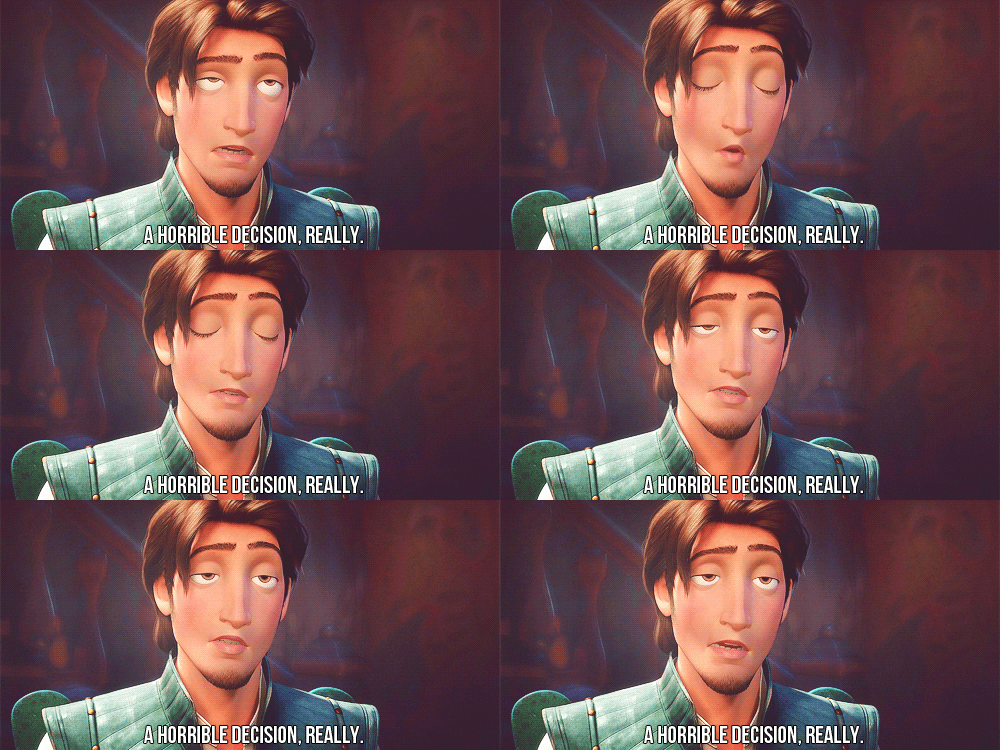
Watching House of Cards, one pattern always stood out: decisions rarely stalled because there wasn’t a solution. They stalled because too many stakeholders had competing priorities.
B2B deals behave the same way. The biggest competitor in B2B isn’t another vendor; it’s no decision. |
In fact, the scale of the problem is larger than most teams realize. According to Forrester’s State of Business Buying, 86% of B2B purchases stall during the buying process. Even when buyers complete a purchase, 81% report dissatisfaction with the provider they ultimately choose — a sign of how difficult modern buying decisions have become.
When buying groups expand, and risk tolerance shrinks, the easiest choice becomes delaying the decision. This week: why deals stall — and how revenue teams reduce the risk of “no decision.” |
|
|
Looking for the business signals everyone else ignores? The Hustle delivers unconventional tech trends and strange business models gaining traction — read by 1.5 million professionals every morning.
👉 Subscribe today. |
|
|
Most Deals Don’t Lose. They Stall. |
Stalled deals are usually alignment problems, not pipeline problems.
The buying process itself has become more complex. McKinsey’s B2B Pulse Survey shows buyers now use an average of 10 interaction channels during the buying journey, up from five in 2016. More stakeholders means more inputs and friction.
The TrustRadius 2024 B2B Buying Disconnect Report found that 78% of buyers already knew the products they planned to buy before starting their research. This means internal preferences and biases often shape decisions before vendors even enter the conversation. The stall pattern is familiar:
A champion pushes the idea forward.
A proposal gets shared.
Momentum fades. |
Three dynamics usually cause it. 🧩 1. Internal consensus breaks down.
Finance evaluates cost. IT evaluates risk. Operations evaluates disruption. If those perspectives never align, the project pauses. 👉 Do this: Equip champions with materials designed for internal conversations — ROI summaries, risk mitigation, and implementation clarity. ⚠️ 2. Risk overtakes urgency.
When priorities shift or budgets tighten, the perceived cost of change rises. 👉 Do this: Frame the operational or financial cost of delaying the decision. 🔄 3. Momentum fades. Complex deals rely on sustained engagement. Missed meetings, delayed approvals, or competing initiatives can quietly push a project off the agenda. 👉 Do this: Define next steps after every interaction and expand stakeholder coverage early. 🎯 Takeaway:
Stalled deals rarely reflect product fit. They reflect unresolved organizational risk. |
|
|
Decision Enablement Is the Missing Layer |
Marketing teams typically focus on generating demand.
But preventing stalled deals requires supporting the internal decision-making process and learning how to find decision-makers in a company.
By the time most vendors enter the conversation, the buyer journey is already well underway. Research from 6sense shows that buyers complete about 70% of their buying journey before engaging with sellers. That means internal conversations are already forming long before a sales call. |
The challenge is that those conversations rarely revolve around product features. They focus on risk, implementation, cost, and organizational impact. Yet much of B2B content still emphasizes product capabilities rather than helping buyers build internal consensus. That’s why high-performing marketing teams increasingly focus on decision enablement, creating assets designed for buying committees: |
- ROI summaries for financial stakeholders
- Security and compliance documentation
- Implementation timelines for operational teams
- Internal decks champions can share with leadership
|
|
|
These materials help buyers translate interest into internal agreement. 🎯 Final Thought: Demand creates opportunity. Decision enablement prevents “no decision.” |
|
|
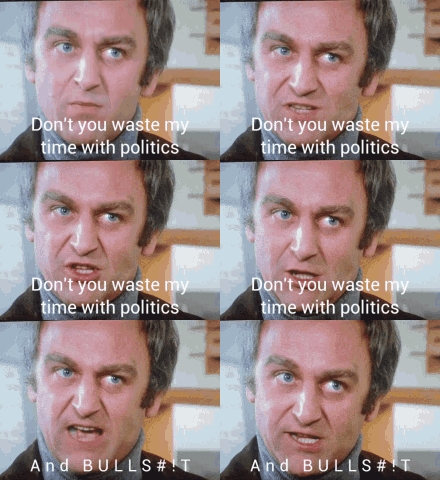
If House of Cards taught us anything, it’s this: the person with the title isn’t always the person with the power. B2B deals work the same way.
I recently listened to an episode of Anti-Marketing with Sajin Nair (B2B Deals Die in Politics), and his argument was blunt: most B2B deals don’t collapse because of product gaps — they collapse because of internal politics. |
GTM teams often map the deal incorrectly. They identify a champion, track engagement, and assume momentum equals influence. But the real decision dynamics are often hidden: stakeholders with veto power, risk owners protecting their domain, or leaders quietly stalling initiatives that threaten existing systems.
In other words, the org chart isn’t the power map. That’s why deals that look “aligned” suddenly drift. The champion had enthusiasm, but not political capital. 👉 Action step: Before the next stage of a deal, ask two questions:
Who benefits most if this decision moves forward?
And who carries the most risk if it does? If you can’t answer both, the deal isn’t stalled yet, but it probably will be. |
|
|
|
Bianca has spent the past four years helping businesses strengthen relationships and boost performance through strategic sales and customer engagement initiatives. Drawing on her experience in field sales and territory management, she transforms real-world expertise into actionable insights that drive growth and foster lasting client partnerships. |
|
|
Selling Signals is a TechnologyAdvice business © 2026 TechnologyAdvice, LLC. All rights reserved. TechnologyAdvice, 3343 Perimeter Hill Dr., Suite 215, Nashville, TN 37211, USA. |
|
|
|