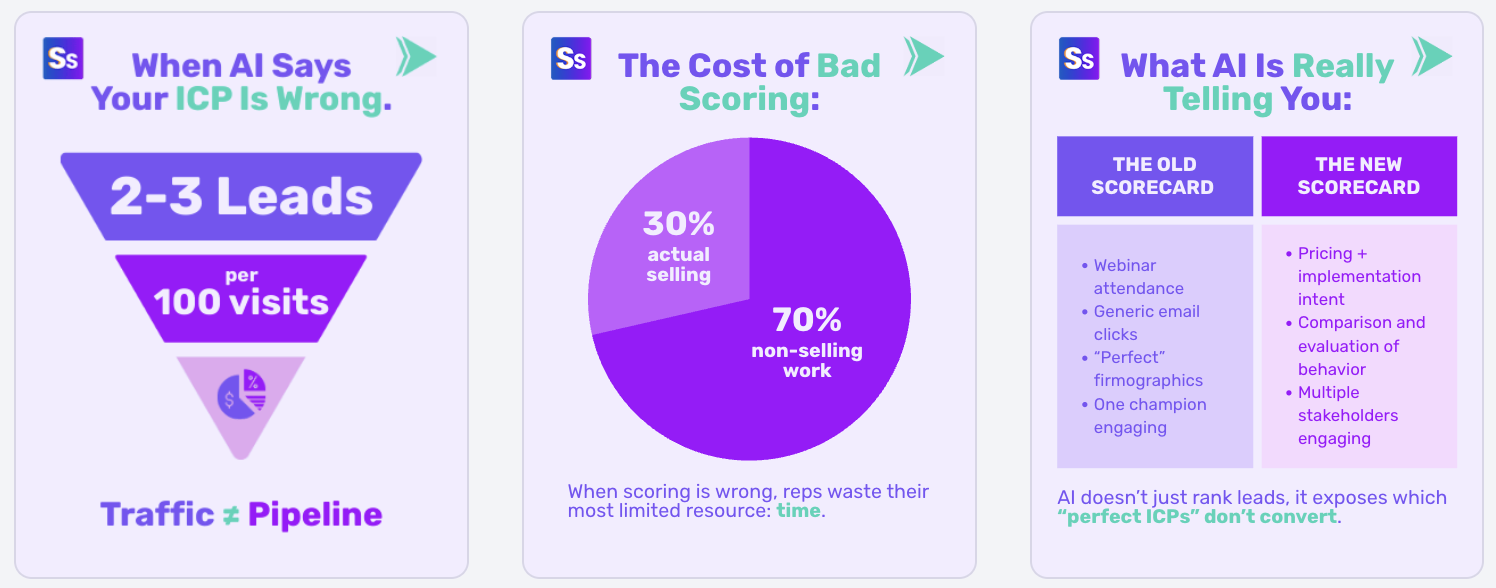
In fact, 53% of marketers say they meet lead generation goals only to some or no extent — highlighting how much the pipeline never fully materializes.
What to look at instead:
Coverage matters, but so do deal quality, urgency, and buying-group engagement.
❌ Myth 2: Late-stage pipeline is safer.
Stage progression can create false confidence. Deals often appear solid until they stall. When deals slip, win rates drop by 67%, undermining the assumption that the late-stage pipeline is “safe.”
Walters’ key point: A healthy pipeline isn’t what’s reported; it’s what’s been inspected.
What to look at instead:
Look for real momentum: stakeholder expansion, next-step discipline, and active buyer participation.
❌ Myth 3: Pipeline movement follows seller activity.
Boards often see more meetings, emails, and calls as proof of progress. It isn’t.
What to look at instead:
Measure buyer movement, not seller motion. Progress happens when buyers align internally and make decisions.
❌ Myth 4: Pipeline is owned by sales.
By the time a deal enters the pipeline, much of the buyer’s thinking is already shaped.
What to look at instead:
Treat the pipeline as a shared output of marketing visibility, sales execution, and buyer confidence.
❌ Myth 5: Historical conversion rates are stable.
Board forecasts often rely on averages from previous quarters. But conversion rates shift when budgets tighten, priorities change, or buying cycles slow.
What to look at instead:
Use current deal conditions — not static averages — to pressure-test forecasts.
❌ Myth 6: Pipeline problems can be fixed this quarter.
When coverage softens, the instinct is to increase activity immediately. But the pipeline is downstream.
What to look at instead:
Separate short-term conversion fixes from upstream demand gaps. Not every pipeline problem has a near-term solution.