When your funnel slows buyers down |
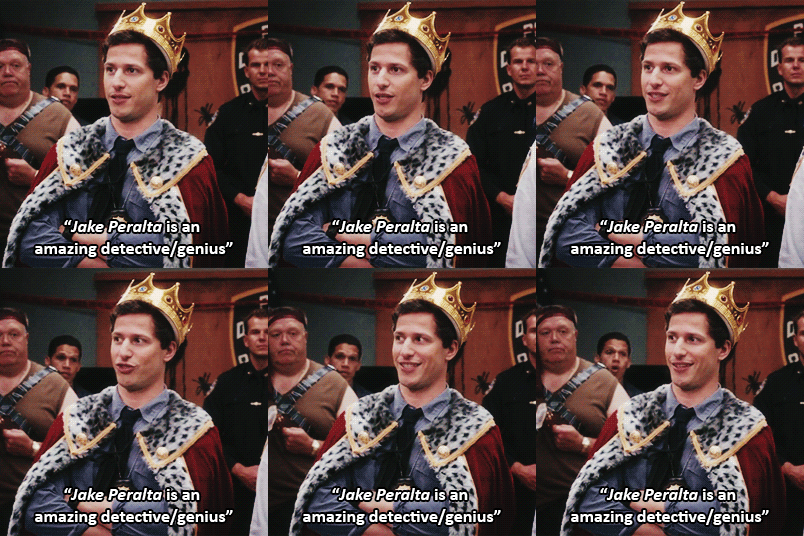
If you’ve ever watched Brooklyn Nine-Nine, you know the Halloween Heists reward one thing: breaking the system. Take the very first heist. Jake Peralta spends the entire episode acting immature, unserious, and a little chaotic. Captain Holt, of course, assumes he’s in control. He plays it straight, follows the rules, and trusts that structure will win.
Then, at the end, Jake flips it. He reveals he swapped the medal earlier and had been playing Holt the whole time. He didn’t win by outworking Holt. He won by making Holt believe in the wrong system. |
That’s what got me thinking this week: What if we deleted every lead form? No gated ebooks. No demo requests. No forcing buyers to identify themselves just to access basic information. It sounds like an April Fools’ joke. But the behavior behind it isn’t.
TrustRadius research shows that 78% of buyers shortlist vendors they already know before they even begin researching, and 71% end up choosing that initial top choice. Buyers aren’t entering your funnel to discover you. They’re entering to confirm what they already believe.
Most sales funnels assume buyers will trade information for access early. Buyers are doing the opposite. They research independently, validate quietly, and engage only when they’re ready. Which raises the real question: are we optimizing the right system or just getting better at the wrong one? |
|
|
Forms Capture Demand After It’s Already Formed |
Sales teams are still structured around the simple assumption that once a lead comes in, the opportunity begins. But the data suggests the opposite.
If buyers are shortlisting vendors before they research — and sticking with that initial choice — then by the time a form is filled, most of the decision has already happened. |
At the same time, buying cycles are moving quickly. Nearly 90% of buyers complete purchases within six months, and 56% rely on peer conversations during the process. That means buyers are validating decisions externally while moving fast internally, often without direct interaction from vendors.
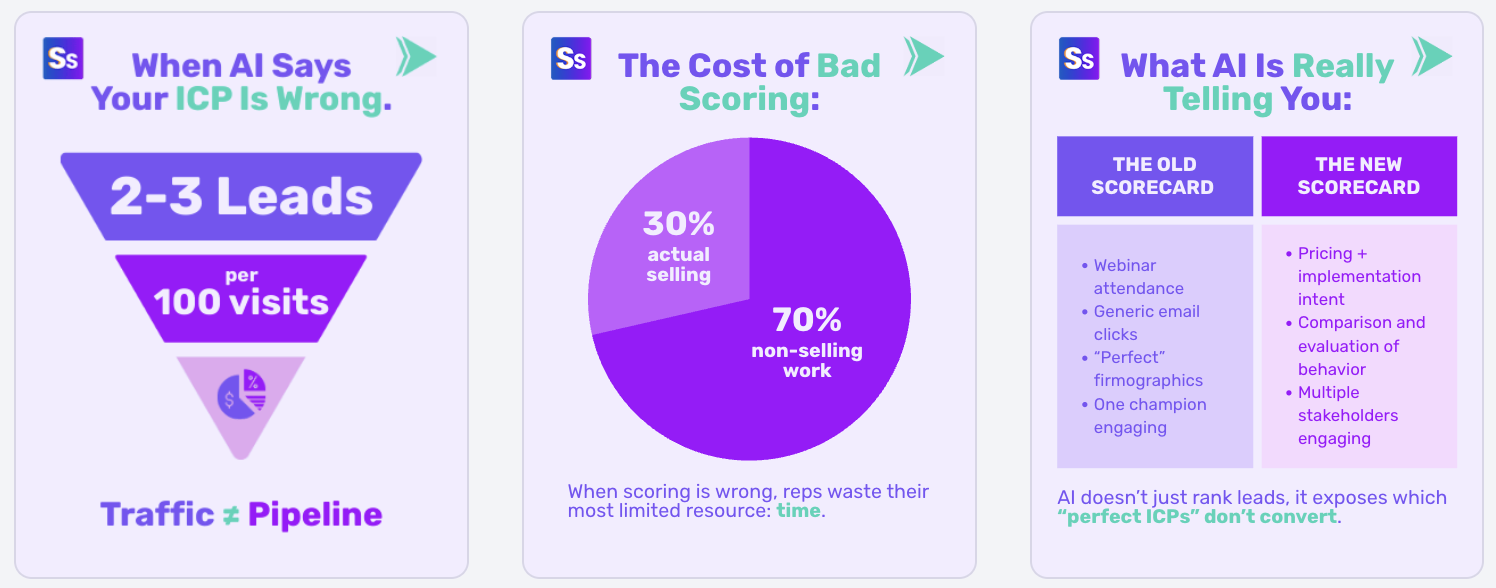
This is where form-first thinking breaks down. Sales teams respond to the form, but the real decision has already been shaped elsewhere — through content, peer input, and prior exposure. Sales needs to operate the same way now. 📊 Look beyond the form to identify active buyers.
Track engagement patterns, returning visitors, and product exploration to understand who is already evaluating. 🎥 Remove friction from validation stages.
Make it easy for buyers to access product details, comparisons, and use cases without requiring a meeting. 🧩 Align conversations with buyer progression.
Assume the buyer has context. Focus on helping them decide, not educating from scratch. High-performing teams don’t rely on forms to tell them who’s interested. They look for signals that show who’s already moving. |
Forms don’t create opportunities. They surface decisions that are already underway. |
|
|
Demand Is Built Before the Funnel |
Marketing has long been measured by its ability to generate leads. Campaigns drive traffic, content builds interest, and forms convert that activity into a pipeline. But this model assumes the funnel is where demand begins when it isn’t. |
The majority of enterprise buyers shortlist vendors they’ve already heard of, while 53% of marketing budgets are still allocated toward demand generation compared to 38% toward brand. That imbalance reveals that teams are over-investing in capturing demand and under-investing in creating it. When buyers already know who they trust before they convert, the role of marketing shifts from driving form fills early to building familiarity before the funnel even starts. Here’s what to do: 🔄 Shift from capture to visibility.
Ensure your brand shows up consistently across the channels buyers use to research. 🔄 Prioritize familiarity over immediate conversion.
Buyers are more likely to choose vendors they recognize before they engage. 🔄 Invest in presence, not just performance.
Demand generation without brand support creates short-term spikes, not a sustained pipeline. |
|
|
Forms don’t create demand. They capture the result of it. |
|
|
Marketing: “We need more leads.”
Sales: “These leads aren’t ready.” That tension is usually framed as a quality issue. But more often, it’s a visibility issue. When marketing focuses on generating leads, it optimizes for the moment a buyer enters the funnel. But if buyers are already shortlisting vendors before that moment, then the real competition happens earlier — outside the funnel entirely.
Sales feels this disconnect. Leads come in, but they’re either too early to convert or already biased toward another vendor. Marketing responds by pushing for more volume, hoping to compensate. The result is predictable: more leads, same problem.
At the same time, the highest-intent buyers often remain invisible. They research independently, rely on peers, and move quickly once they decide. By the time they engage, they’ve already narrowed their options. And if your brand wasn’t part of that early consideration, you’re not in the deal. |
That’s the gap most teams miss. Forms work, but sometimes they capture demand too late to influence it. The strongest teams adjust their focus, invest earlier, and build familiarity before intent shows up. Plus, they align sales and marketing around buyer progression, not just lead volume. 🌟 Action: Pressure-test your funnel. If buyers are deciding before they convert, where are you influencing that decision? If the answer is “after the form,” you’re already late.
The goal isn’t to eliminate forms, but to stop relying on them to define your pipeline. |
|
|
Enjoyed this issue?
We break down how buyers actually move and what top teams do differently. If you’re rethinking your funnel or pipeline, catch up with our past issues. |
|
|
More ways to connect with Selling Signals! |
Get the latest in sales and marketing without opening your email. Follow us on LinkedIn or Facebook for swipeable frameworks, bite-sized visual breakdowns, and a chance to join the conversation. |
|
|
|
Bianca has spent the past four years helping businesses strengthen relationships and boost performance through strategic sales and customer engagement initiatives. Drawing on her experience in field sales and territory management, she transforms real-world expertise into actionable insights that drive growth and foster lasting client partnerships. |
|
|
Selling Signals is a TechnologyAdvice business © 2026 TechnologyAdvice, LLC. All rights reserved. TechnologyAdvice, 3343 Perimeter Hill Dr., Suite 215, Nashville, TN 37211, USA. |
|
|
|