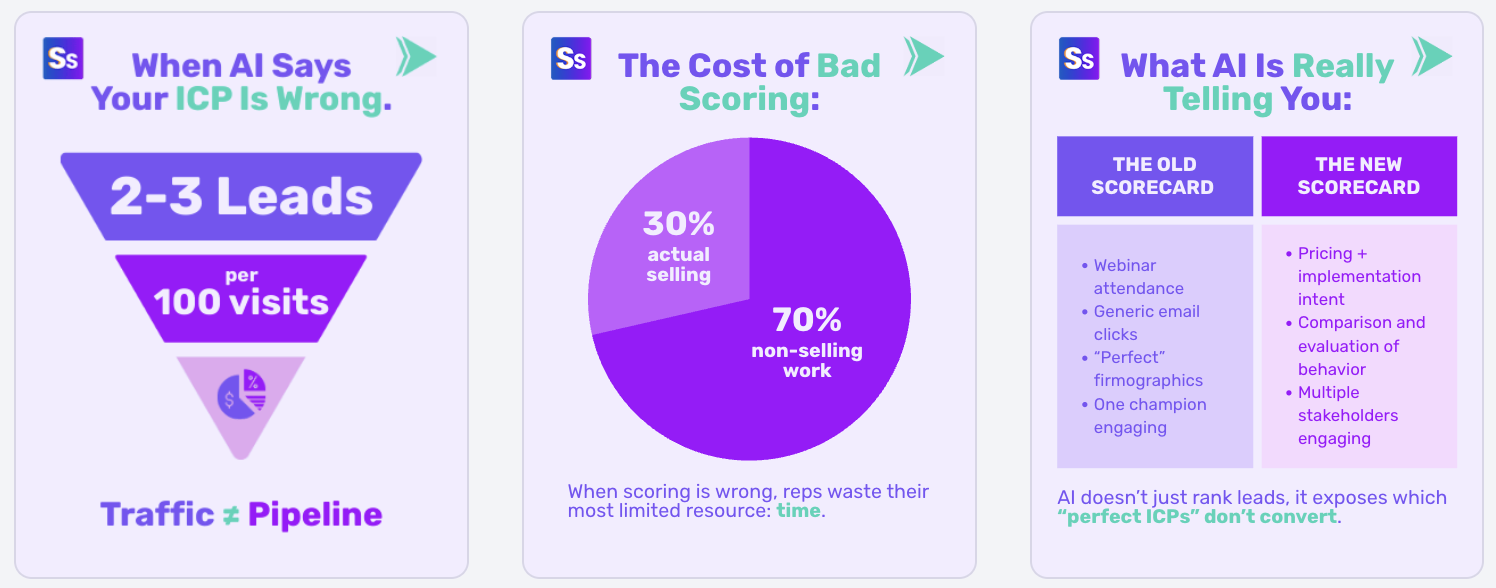
When your pipeline looks strong but isn’t |
A recent 2026 B2B marketing forecast highlights something most teams are already running into: More data hasn’t made pipeline more predictable. It has only made it easier to get it wrong.
We’re tracking more than ever — more clicks, more conversions, more signals. And on paper, that should make forecasting tighter. Instead, it’s creating false confidence. Because most of what shows up early in the quarter isn’t buying behavior but interaction. Activity looks like progress. Engagement looks like intent. Pipeline fills up fast. But none of that tells you if deals will actually move.
That’s where coverage assumptions start to break. While we’re asking if we have enough pipeline, the real question we should be asking is: “How much of this pipeline is real?” |
|
|
Why coverage assumptions fail |
Marketing still plans around scale — more campaigns, more leads, more pipeline. But the pipeline today isn’t uniform; it’s uneven.
Different sources behave differently. Paid drives fast entry, content drives early engagement, while product and referrals drive actual conversion. Yet they’re all counted the same. That’s where coverage breaks — because it measures volume, not conversion potential. At the same time, signals are getting noisier: |
-
More content → more low-intent engagement
- More channels → fragmented journeys
- More tracking → more false confidence
|
So pipeline looks strong early — targets are hit, engagement is high, and conversion events are happening. And yet, none of that reflects whether buyers are actually moving.
Coverage assumes consistency. But today’s pipeline isn’t consistent; it’s front-loaded with activity and uneven in intent. |
|
|
| “Don’t trust total pipeline — break it down and pressure-test it. Segment by source, then track which ones actually progress within the first seven to 14 days. If a channel consistently generates pipeline that doesn’t move, stop counting it as real coverage.” - Ian Richardson, Managing Partner at Fox & Crow Group |
|
|
What marketing should do instead |
If coverage can’t tell you pipeline quality, you need to pressure-test it early. Here’s how:
📊 Segment pipeline by source — and track how it behaves Don’t just report the total pipeline. Break it down by channel, campaign, type, and entry point. Then, track the following to determine which sources actually move: |
- Progression rates
- Time to the next step
- Conversion to opportunity
|
⏱ Measure “time to next action,” not just conversion Track the following: |
- How fast leads return
- How quickly they engage again
- Whether they take a second meaningful action
|
The strongest pipeline shows momentum quickly. If nothing happens within days, it’s unlikely to convert later. 🔁 Require signal stacking, not single events
Stop treating one action as intent. Instead, define qualification as: |
- Multiple touches
- Repeated engagement
- Cross-channel behavior
|
If signals don’t stack, don’t count it as a real pipeline. |
⚠️ Discount shallow pipeline early Not all pipeline deserves equal weight. Before forecasting, pressure-test: |
- Which deals have no follow-through
- Which leads haven’t re-engaged
- Which sources historically underperform
|
Then down-weight or exclude them from your real coverage view.
The goal is to understand early on which pipeline actually behaves like revenue. Because if you wait for conversion rates to tell you what’s wrong, you’re already too late. |
|
|
Early signals your pipeline won’t convert |
If the pipeline is inflated by activity instead of real buying intent, sales sees it first in how deals behave. Here’s what to watch early:
📊 Fast entry, no follow-through Opportunities get created. First calls happen. However, if these are not present, then that’s just a lead that never converted: |
- No reply after the initial outreach
- No second meeting
- No next step confirmed
|
Don’t carry it forward. If there’s no follow-through within a few days, it’s already weak. 📉 Single-threaded deals One contact is engaged. But it’s only a conversation and not a deal if there are no:
|
- Additional stakeholders
- Internal alignment
- Expansion beyond the initial conversation
|
If you can’t multi-thread early, the deal rarely recovers later. |
⚠️ Interest without urgency The prospect shows up. Takes the call. Asks questions. But watch out for the signs that it’s only curiosity and not a priority: |
- No clear timeline
- No defined problem to solve now
- No consequence for waiting
|
If urgency isn’t clear by the second interaction, it usually doesn’t appear later. ⏳ Slipping next steps
Meetings get pushed. Replies slow down. Timelines stay vague. Momentum fades instead of coming back. If the buyer won’t commit to a next step with a date and outcome, it’s not a real opportunity. The best sales teams don’t evaluate pipeline at creation. Instead, they evaluate the following: |
- Follow-through
- Stakeholder depth
- Urgency
- Strength of next steps
|
Because the pipeline doesn’t fail at close. It fails in the first few interactions. |
|
|
|
“Treat the second interaction as the real qualification point. If there’s no confirmed next step, no stakeholder expansion, or no urgency after the first touch, downgrade or disqualify the deal early instead of carrying it through the forecast.” - Julie Thomas, President and CEO of ValueSelling Associates |
|
|
If a deal isn’t building momentum early, don’t nurture it. Instead, remove it, re-qualify it, or stop forecasting it. |
|
|
Marketing: “Engagement is up.”
Sales: “This isn’t converting.” That gap isn’t about effort but about what’s being measured. Marketing sees interaction, while sales experiences intent. So marketing generates more, and sales works what’s there. And the outcome doesn’t change.
The strongest teams shift earlier. They don’t ask if we generated enough pipeline. Instead, they ask: “Did this pipeline show signs of real buying behavior?” Because if it didn’t, it won’t convert, no matter how good it looks on a dashboard. |
|
|
Submissions have been edited for length & clarity |
|
|
|
What’s a signal you trust in week 1-2 of a quarter that most teams completely ignore? “Early on, I look at whether the pipeline is actually grounded in something real, or just surface-level engagement. A lot of teams count early-stage opportunities the same, but if those deals aren’t tied to a clearly defined problem or buying motion, they tend to stall quickly.
In the first couple of weeks, that gap shows up fast. You can usually tell which opportunities are built on real intent and which ones were created too early.” What’s one number that looks healthy early in the quarter but almost always leads to a miss later?
“Pipeline coverage multiples are the biggest one. Seeing 3-4x coverage early creates confidence, but that number is usually based on uniform conversion assumptions. The problem is that those assumptions don’t hold if the underlying pipeline isn’t well-qualified. The math looks sound, but it’s applied to deals that don’t actually have the same likelihood of closing. That’s where teams feel good early and miss later.” - Paul L. Gunn, Jr., Founder of KUOG Corporation |
|
| Enjoyed this issue?
We break down how buyers actually move and what top teams do differently. If you’re rethinking your funnel or pipeline, catch up with our past issues. |
|
|
More ways to connect with Selling Signals! |
Get the latest in sales and marketing without opening your email. Follow us on LinkedIn or Facebook for swipeable frameworks, bite-sized visual breakdowns, and a chance to join the conversation. |
|
|
|
Bianca has spent the past four years helping businesses strengthen relationships and boost performance through strategic sales and customer engagement initiatives. Drawing on her experience in field sales and territory management, she transforms real-world expertise into actionable insights that drive growth and foster lasting client partnerships. |
|
|
Selling Signals is a TechnologyAdvice business © 2026 TechnologyAdvice, LLC. All rights reserved. TechnologyAdvice, 3343 Perimeter Hill Dr., Suite 215, Nashville, TN 37211, USA. |
|
|
|