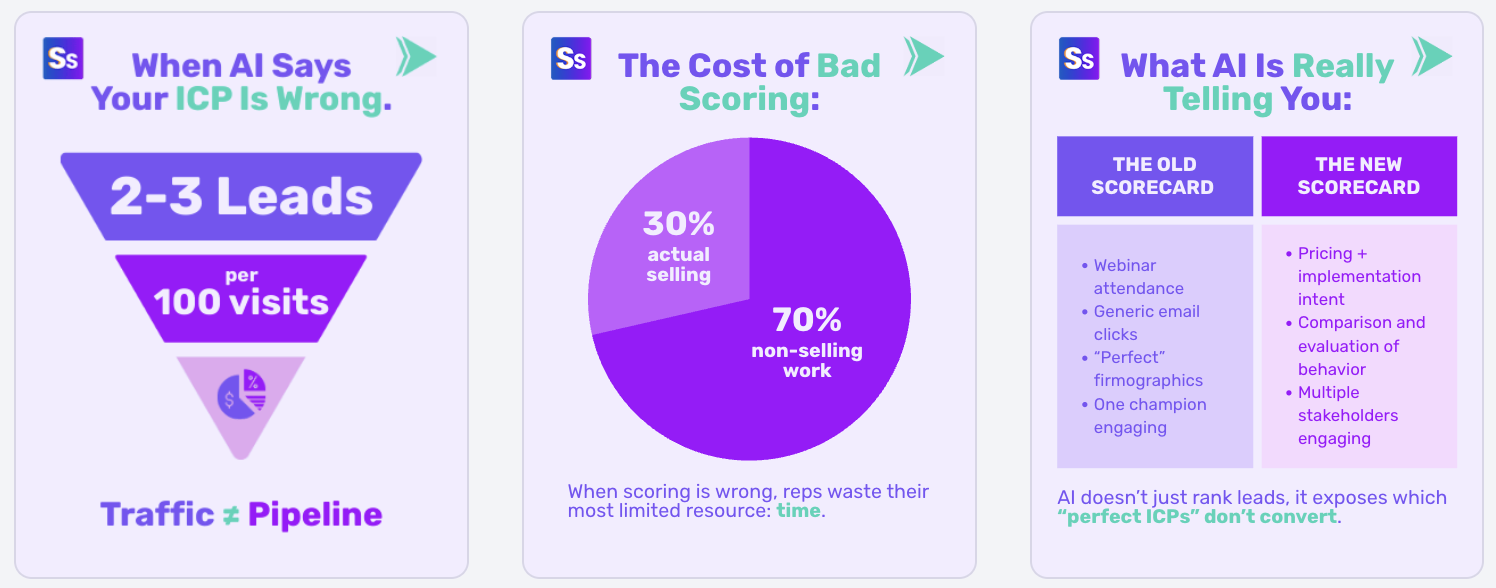
Thursday Brief: Pipeline accountability is getting harder to avoid. |
Energize Marketing’s 2026 demand gen research, based on a survey of 300+ tech marketing decision-makers, says 52% of marketers now rank driving qualified pipeline as their top priority, and more than 90% include pipeline, ABM, or lead quality among their top goals. It also says success is now defined by pipeline impact, account focus, and execution efficiency, not volume-driven tactics.
The buying environment is getting messier, and at the same time, expectations are getting stricter. Energize says buying committees are larger, stakeholders are harder to identify, and journeys are increasingly long, nonlinear, and fragmented. Traditional lead models and attribution frameworks were not built for that reality. |
I spoke with our CMO, Tyler Lessard, about what’s changing here. His take:
“Activity alone isn’t a qualification. It has to be paired with fit.” That’s the real shift — the challenge isn’t generating pipeline anymore. It’s proving it actually means something. |
|
|
What’s the biggest lie in your pipeline right now?
|
|
|
The pipeline mandate is no longer optional.
Energize’s report is the clearest signal in the bunch: demand gen is now being measured by its contribution to revenue, not just activity or lead volume. The report explicitly says the pipeline is no longer something marketing merely influences; it is something marketing is expected to deliver. It also notes that 40% of organizations now prioritize scaling ABM, making it the second-highest focus area after pipeline creation.
For GTM teams, that shifts the conversation from “how much did we generate?” to “how much of this actually progressed?” If pipeline is the metric, then weak qualification, shallow handoffs, and channel-first reporting stop being marketing problems and start becoming shared GTM problems. Energize is blunt on this too: lead-based models do not reflect deal momentum, and traditional attribution breaks down under committee buying.
🧠 Why this matters for GTM This is where things start to break: |
- Marketing optimizes for pipeline creation
- Sales evaluates pipeline quality
- Leadership expects pipeline predictability
|
If those aren’t aligned, you don’t get more revenue. Instead, you get more pipeline that needs to be filtered later. That’s the real risk behind the pipeline mandate: it exposes whether your qualification model actually reflects buying behavior or just activity. |
-
Shift from entry to progression. Track what happens after the pipeline is created, not just that it was created
-
Redefine “qualified.” Require stacked signals, not single events — if your team is still debating what actually counts as “qualified,” reset using this lead qualification framework.
- Audit false positives. Pull a recent “qualified” cohort and check how many progressed within 2 weeks
|
Because if the pipeline isn’t moving early, it’s not a pipeline problem; it’s a qualification problem. |
Oracle’s layoffs are really an ops accountability story. Forrester’s read on Oracle is sharper than the usual “AI is replacing jobs” headline. Their point is that this is really about an operating model under stress. As they put it, when capital gets tight, organizations stop funding effort and start funding outcomes. AI accelerates that shift, but does not cause it. |
That has direct implications for marketing ops, sales ops, and RevOps. Forrester argues that the functions that survive are the ones that can explain where human judgment is still required, how AI-assisted decisions are governed, and how errors are caught and corrected. They also recommend hypothesis-driven, time-boxed pilots measured on decision quality, not activity, and say ops leaders must show how AI improves decision effectiveness, reduces rework, and protects revenue outcomes.
This is less about tooling than defensibility. If your ops model cannot explain ownership, overrides, and risk management, it starts to look like overhead instead of leverage. 🧠 Why this matters for RevOps / GTM leaders Ops is no longer just enabling execution. It’s responsible for: |
-
Decision integrity (are we making the right calls?)
- System clarity (who owns what?)
- Risk control (how do we catch bad calls early?)
|
If you can’t answer those clearly, your GTM system looks complex, slow, and hard to trust. And that’s when it gets cut. 🛠️ What to do |
- Map decision ownership. Qualification, routing, forecasting — who actually owns each?
- Audit one decision flow. Pick one (e.g., lead scoring) and define inputs, logic, and override rules.
-
Simplify where possible. If a process requires explanation, it’s already a liability
|
Because in this environment, clarity is leverage. Complexity is cost. |
Zero-click isn’t killing B2B thought leadership; it’s raising the bar. PRSA’s take goes beyond the common panic echoing “RIP traffic.”
Yes, zero-click search is massive. The article says AI-generated search results now account for about 80% of Google searches. But it also argues that B2B buyers are not typical zero-click users: they use more channels, spend meaningful time with thought leadership, and still click through when the stakes are high. PRSA cites research saying 90% of B2B readers click through to the sources or citations behind AI Overviews. That changes the real question.
It’s not whether thought leadership still matters. PRSA is explicit that it does. The question is whether your content is built to earn the citation, survive the summary, and still be worth the click. The authors argue AI search may actually create more opportunity for B2B thought leadership, but only for teams producing content with depth, specificity, and strong structure.
🧠 Why this matters for marketing + GTM Generic content is in trouble. |
If your content is vague, thin, or built to fill a calendar, AI can summarize it, flatten it, and move on. But if it is specific, useful, and clearly structured, it has a better shot at being cited in AI Overviews and used by buyers doing deeper research. PRSA also notes that LinkedIn and YouTube are among the top domains cited in Google AI Overviews, which matters if your distribution strategy still assumes buyers will patiently arrive on your blog and admire the CTA. In other words: content still influences pipeline — it just doesn’t always do it in a neat, click-first way. If you’re still treating search like a traffic channel, you’re missing how AI-powered search is changing B2B buying behavior. 🛠️ What to do |
- Keep the SEO basics. PRSA explicitly recommends matching content to search intent, maintaining proper HTML structure, and publishing fresh stories.
- Publish beyond your site. The article specifically recommends broader distribution across LinkedIn, YouTube, social media, and trade publications to improve visibility and citation likelihood.
- Write for real buyer queries. Use specific questions, detailed use cases, and deeper answers instead of generic “best practices” filler.
- Proliferate your best ideas. Turn one strong asset into blogs, videos, slides, checklists, FAQs, or comparison charts so the same expertise appears in multiple AI- and search-friendly formats.
-
Obsess over structure. PRSA calls out concise summaries, strong headings, lists, and short paragraphs because AI systems and human readers both reward content that is easy to parse.
|
Because in a zero-click world, the win is not just “get the click.” It is: be the source buyers see, trust, and choose to validate further. |
This week’s signals all point in the same direction: |
- The pipeline is being scrutinized
- Ops is being evaluated
- Qualification is being redefined
|
And the common thread is this: The system is being tested. Not just how much it produces, but how well it reflects reality.
The teams that adapt fastest won’t just generate a pipeline. They’ll build systems that can prove it’s real. |
|
|
Enjoyed this issue?
We break down how buyers actually move and what top teams do differently. If you’re rethinking your funnel or pipeline, catch up with our past issues. |
|
|
More ways to connect with Selling Signals! |
Get the latest in sales and marketing without opening your email. Follow us on LinkedIn or Facebook for swipeable frameworks, bite-sized visual breakdowns, and a chance to join the conversation. |
|
|
|
Bianca has spent the past four years helping businesses strengthen relationships and boost performance through strategic sales and customer engagement initiatives. Drawing on her experience in field sales and territory management, she transforms real-world expertise into actionable insights that drive growth and foster lasting client partnerships. |
|
|
Selling Signals is a TechnologyAdvice business © 2026 TechnologyAdvice, LLC. All rights reserved. TechnologyAdvice, 3343 Perimeter Hill Dr., Suite 215, Nashville, TN 37211, USA. |
|
|
|