-
News & Trends -
Sales -
Marketing Related Topics -
B2B Software Guides Related Topics -
Free Tools & Resources -
- About Us About Us
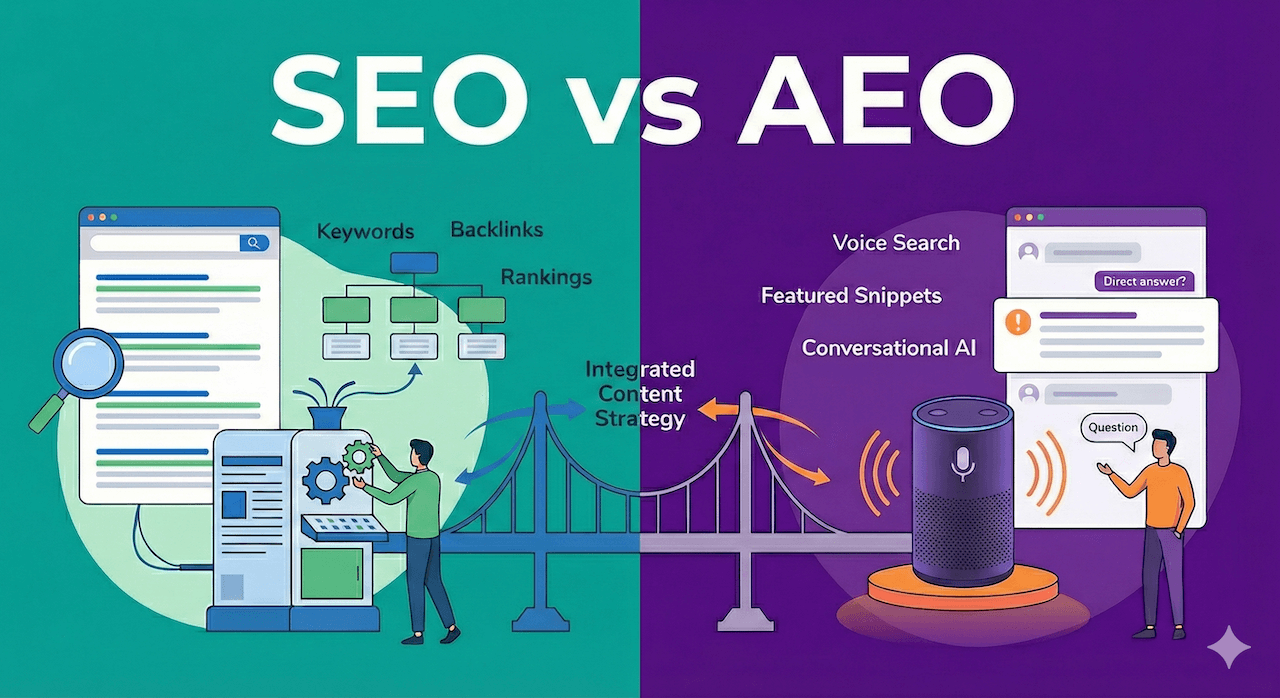
Clickable citations now sit at the core of AI responses. They're fundamentally rewriting how prospects discover brands and are part of an ongoing trend towards GEO vs SEO (or generative engine optimization over search engine optimization). And they're the reason that legacy SEO and marketing teams have been switching gears to focus on new (but still theoretical) authority signals.
So, it's safe to say that what we're experiencing isn't just another round of algo updates. Once upon a time, every marketer was swearing up and down that it's essential to write for people, not robots. But now that we've crossed over into the new year, success in digital AI-dominated spaces may require unique stories designed for human readers and architecture designed for machine comprehension.
Traditionally, teams have relied on factors such as keywords and backlinks to demonstrate topic authority. But sources report that 97.2% of AI citations cannot be explained solely by backlinks. Instead, tools like Perplexity prioritize user-generated content from community platforms like Reddit, YouTube, and LinkedIn.
Meanwhile, ChatGPT prefers Wikipedia and trusted review sites (or review-heavy sites) such as G2, Forbes, and Amazon. And now that 50% of Google's search results display AI summaries, just as many consumers intentionally use AI search engines, according to a 2025 McKinsey survey.
Overall, the algorithms that decide what articles, sources, and information to display treat web pages as "databases of responses" rather than as sets of linear text from which machines extract data in clearly segmented blocks. Where not ranking on page one was once a guarantee of invisibility, now almost 90% of ChatGPT citations come from pages not ranking on the first or second search result page.
AIO search visibility is changing the game and making a massive difference to the B2B bottom line (with ChatGPT recommendations, sales conversions have surged by 436%). And while there are no guarantees that one practice or another will get your content cited by AI, some patterns are emerging that can certainly help.
How teams gain AI visibility challenges long-held assumptions about which content works best. Previously, it was important for content not to date itself. Evergreen content was designed so that anyone could get something out of it, regardless of when they consumed it.
Now, research shows that 70% of AI-cited pages were updated within 12 months of an AirOps study published in August 2025. Specifically, AirOps studied "4,000 pages cited by ChatGPT across 900 high-intent queries in 15 major industries" to discover key attributes of visible content. Of that, 35.2% were updated in the last three months, and 26.2% hadn't been updated in the previous year.
Previously, may B2B bloggers would forgo displaying publishing dates on their content. But now, updates matter. To keep up with this shift, make sure your publish dates are up to date when working on website-based content campaigns, including blogs, case studies, infographics, and more.
Comparison articles, listicles, and reviews have gained significant traction in AI citations, accounting for 32.5% of the citations analyzed. This means your brand is more likely to appear in an AI citation when mentioned by a third party, rather than on your own domain.
That's because, it seems, AI is searching for mentions across the web. According to an analysis of 75,000 brands by Ahrefs, brands with more mentions overall were more likely to appear in AI overviews. Those in the top 25% of brand mentions saw an average of 169 AI overview mentions, compared to an average of just 14 mentions for brands in the next quartile.
Additionally, context-rich mentions are proving more valuable than traditional link building. One digital marketing agency reported that AI citations rewarded brands that appeared repeatedly in trusted third-party sources, even when no link to the brand was present.
Meanwhile, brands mentioned positively across at least four non-affiliated forums were 2.8 times more likely to appear in ChatGPT responses than brands mentioned only on their own websites.
Unfortunately, traditional content marketing approaches optimized for human engagement have actively worked against AI citation algorithms.
That’s because AI engines don’t consume pages like people do; they extract reusable answers. And content built around long intros, narrative flow, or “read time” signals often hides the exact information the model is trying to cite.
Structure requirements proved more demanding than anyone predicted. In its analysis of 12,000+ URLs across 900 high-intent queries, AirOps found that 68.7% of ChatGPT-cited pages used sequential heading structures, compared to 23.9% of Google’s top results. This means cited pages were nearly three times as likely to follow a clear heading hierarchy.
Even more specific: AirOps found that nearly 4 out of 5 ChatGPT-cited URLs include at least one section with a list, reinforcing how strongly AI engines reward information that’s already organized into extractable blocks.
Tables matter too, but not because every cited page has one. Instead, citations appear disproportionately skewed toward structured formats. One dataset analysis found that 30% of ChatGPT citations included a table, compared to 13% of Google URLs — making AI citations 2.3x more likely to pull from table-based content than traditional search results.
From these studies, it's clear that AI engines reward clarity more than narrative. If your content is still built around long paragraphs and delayed answers, it may be losing citation potential, even if it ranks well.
To adapt, publish content that’s built like a reference: clean heading hierarchies, quick-answer sections, structured lists, and comparison data that makes decisions easy for both buyers and machines.
In a world where AI can summarize almost anything, “good enough” content becomes invisible fast.
That’s because the strongest citation signal isn't keyword coverage, it’s information gain, or what your page or content adds that isn’t already everywhere else.
This is also where EEAT shifts from being a best practice into a competitive edge. Google’s EEAT framework explicitly emphasizes experience and trust as quality signals, and those concepts translate cleanly into AI visibility because AI systems still need sources that demonstrate first-hand credibility and reliable evaluation, not just surface-level descriptions.
Generative engines are also forcing a new optimization model entirely. Recent academic research on generative engine optimization (GEO) argues that LLM-driven discovery shifts away from ranking-only mechanics and toward citation-backed synthesis.
So, sources offering distinct value (original insights, strong evidence, or uniquely structured information) are more likely to be selected into the “answer layer.”
This helps explain why review-heavy platforms, forums, and community sites have become increasingly influential. AI search engines frequently surface spaces where real users share first-hand experiences and comparisons because those environments contain contextual judgment and use-case-driven evaluation that brands often don’t publish themselves.
In practice, building EEAT for AI visibility means creating content that can’t be replicated by rewriting competitor pages. The strongest information-gain signals include unique insights, proprietary data, real-world testing, case studies, niche scenarios, and clear pros and cons that explain trade-offs for specific buyers.
Because if your page doesn’t teach the model something new — or help it make a better recommendation — there’s very little reason for it to cite you.
The most successful approach to AI visibility combines tactical changes with strategic positioning based on what the latest trends show actually works. Start by auditing content for AI-friendly structure: implement clear heading hierarchies, add quick-answer sections, and organize information in lists and tables that AI can easily extract and reuse.
The goal is to make your pages function like reference libraries rather than linear essays built around a long narrative flow.
Next, focus efforts on platforms where AI systems already search for authoritative voices, such as video. SurferSEO's analysis of 46 million AI citations showed that YouTube dominates citations at 23.3% across industries, followed by Wikipedia at 18.4%.
Then, strengthen EEAT through information gain. AI engines increasingly reward content that adds something new rather than repeating what already exists, especially for high-intent, decision-based queries.
That means prioritizing proprietary insights, first-hand testing, niche scenarios, case studies, and clear pros and cons that help buyers understand tradeoffs. Interchangeable summaries are easy for AI to ignore, but original evidence and experience are hard to replace.
Finally, build your third-party footprint strategically, aiming for consistent, factual mentions across respected domains that build semantic authority.
Overall, an AI-first content strategy can establish authority that becomes exponentially harder to displace as AI models learn and reinforce these patterns. Therefore, the question isn’t whether this shift will affect your industry, but whether you’ll take the lead or fall behind.

Selling Signals delivers actionable advice for sales and marketing professionals. Learn strategies that help you hit targets, strengthen customer relationships, and win more business. Get expert advice on lead generation, sales processes, CRM software, sales management, and account management directly to your inbox.
Property of TechnologyAdvice. © 2026 TechnologyAdvice. All Rights Reserved
Advertiser Disclosure: Some of the products that appear on this site are from companies from which TechnologyAdvice receives compensation. This compensation may impact how and where products appear on this site including, for example, the order in which they appear. TechnologyAdvice does not include all companies or all types of products available in the marketplace.