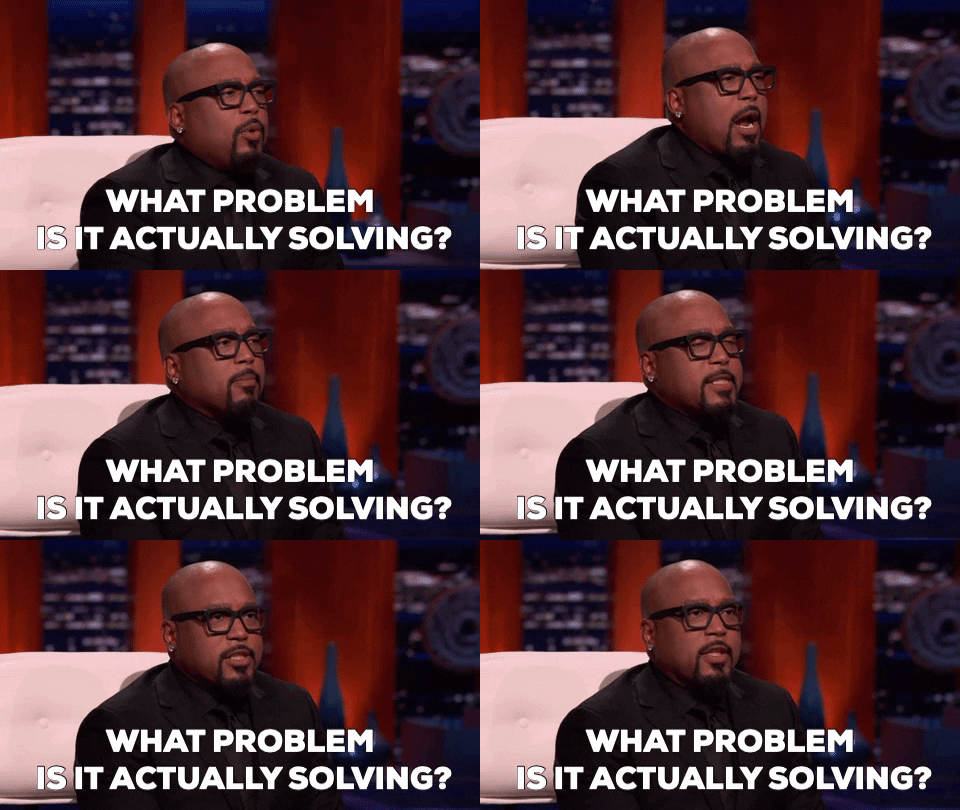
When accountability turns into blame |
Tax Day has a way of making everything feel more visible. Numbers get reviewed. Decisions get questioned. And suddenly, every line item needs an explanation. |
|
|
Why deal reviews break down |
|
|
“The only question I ever ask in a pipeline review that cuts out any sort of blame and gets people to think about action is: ‘At which exact stage did the majority of deals stop advancing, and who decided to advance them?’ The answer to that question needs to be a clear stage, an owner, and a concrete explanation of why things were done in that manner. It’s impossible to deflect after such an inquiry.” |
- Rafael Sarim Oezdemir, Head of Growth at EZContacts |
|
|
Below are some helpful tips that you can apply to pinpoint that stage:
1. Start with the buyer, not the team
Instead of asking “What did we do wrong?”, start with “How did the buyer make this decision?” This moves the conversation away from internal defensiveness and toward external reality. 2. Separate facts from interpretations
Document what actually happened: touchpoints, timing, objections, stakeholders. Then discuss why it mattered. Mixing the two can often lead to opinions disguised as evidence. 3. Define shared ownership
Lost deals are rarely caused by a single function. When accountability is shared, teams focus on improving the system rather than defending their roles. Overall, sales teams would benefit from standardizing the review process. A consistent structure, like an After-Action Review, creates clarity and reduces bias. |
|
|
When attribution becomes a defense mechanism |
- This campaign drove X leads
- This channel influenced pipeline
- This content performed above benchmark
|
All of that can be true, but it’s not always helpful in understanding what actually went wrong. |
As one marketing operations leader put it: |
|
|
“From the marketing ops seat, I’ve seen how quickly teams default to lead quality or volume as the explanation when pipeline misses. [But] the real problem is often upstream: broken handoff logic, scoring models nobody has recalibrated in quarters, or attribution gaps that make it impossible to tell what’s actually working.” |
- Sakshi Patel, Marketing Operations Manager at Truveta |
|
|
That perspective highlights the core issue. Attribution answers what happened, but it doesn’t always explain why it mattered. The tension shows up when performance metrics are used to defend decisions rather than to inform them. Then teams end up optimizing to prove value instead of understanding impact. Three shifts make marketing post-mortems more useful:
1. Move from channel performance to buyer progression
Instead of focusing on which campaign “worked,” look at how buyers moved through the journey. Where did they stall? Where did they accelerate? 2. Align metrics with sales reality
If marketing success is defined by MQLs and sales success is defined by revenue, post-mortems will never align. Shared definitions reduce friction. 3. Treat attribution as a starting point, not a conclusion
Attribution should guide questions, not end them. The goal is to understand how influence translates into action. |
|
|
Sales: “The leads weren’t qualified.”
Marketing: “The campaign performed above benchmark.” |
Both can be true, but neither explains why the deal was lost. |
→ Translation: Post-mortems fail when teams defend performance instead of examining outcomes. The goal isn’t to prove who did their job. It’s to understand why the system didn’t work. |
|
|
Submissions have been edited for length & clarity |
|
|
|
When pipeline misses, what’s the first explanation teams reach for that usually isn’t the real problem? “One common excuse is the state of the market or a customer budget freeze. The sales team will blame the economy, while the marketing team will complain about lead quality. These factors seem out of our hands, and therefore, inevitable.
However, once you dig past these reasons, the problem is almost always a process failure. Reps don’t qualify leads correctly because we haven’t defined what qualifies a lead. The forecasting process is inefficient, and we don’t see the handoff between marketing and sales. In reality, we often have no idea at which stage deals fall through because we never defined clear criteria for success at every stage.”
What’s one review question that gets teams past blame and into action? “Here is my favorite one: ‘What specific stage in our process did we fail to meet our standards?’
No individual, but the stage. This shifts the conversation from personal accountability to process accountability. The rep cannot blame the customer but needs to identify the exact stage we missed — discovery, proposal, or urgency. After that, you can investigate further: was it our process that failed, or did the rep execute it ineffectively? This gives you concrete information on what to fix.”
- Rafael Sarim Oezdemir, Head of Growth at EZContacts |
|
| Enjoyed this issue?
We break down how buyers actually move and what top teams do differently. If you’re rethinking your funnel or pipeline, catch up with our past issues. |
|
|
More ways to connect with Selling Signals! |
Get the latest in sales and marketing without opening your email. Follow us on LinkedIn or Facebook for swipeable frameworks, bite-sized visual breakdowns, and a chance to join the conversation. |
|
|
|
Faithe has spent more than a decade helping people understand the tools that move business forward. With a Ph.D. in Communication Studies, she breaks down project management, office tech, and social platforms into practical insights for sales and marketing teams. |
|
|
Selling Signals is a TechnologyAdvice business © 2026 TechnologyAdvice, LLC. All rights reserved.
TechnologyAdvice, 3343 Perimeter Hill Dr., Suite 215, Nashville, TN 37211, USA. |
|
|
|