-
News & Trends -
Sales -
Marketing Related Topics -
B2B Software Guides Related Topics -
Free Tools & Resources -
- About Us About Us
Companies and marketing teams that are still vying for keywords (and counting on) perfect Google rankings may, unfortunately, find themselves behind the curve in 2026.
AI-first or AI-powered search engines have become a powerful way for consumers to discover brands and make purchasing decisions. This transition isn't necessarily new, with the rise of zero-click Google search results and "AI overviews" in the last year, where users didn't need to click or tap into an article to get an answer.
But the full switch to users, readers, and buyers relying more fully on AI search isn't theoretical either. Several sources claim that half of consumers already use AI search to find answers.
More accurately, they may be referring to October 2025 McKinsey & Company data that shows between 40% and 55% of consumers in top sectors (consumer electronics, grocery, travel, wellness, apparel, beauty, and financial services) are using AI-based search to make purchasing decisions.
Either way, it's putting B2B and B2C marketers in the race to try to understand the differences between and roles of "AIO search," "AI optimization," and SEO's latest branch, "generative engine optimization" (GEO).
The 2026 reality is that AI platforms could influence $750 billion in revenue within the next three years, according to the same McKinsey report. Yet most organizations remain completely unprepared. Your current SEO success? It offers zero guarantee of AI search visibility.
Traditional SEO strategies are hitting a brick wall, and recent data reveals why. Only 12% of sources, on average, cited in ChatGPT, Gemini, and Copilot rank in the top 10 Google organic results for identical queries, according to an Ahrefs analysis of 15,000 long-tail queries in Google and Bing. So the odds that tried-and-true SEO investments will translate to AI visibility don't look good.
Search behavior itself has fundamentally evolved over the past six months. Query length has grown from four words to 23 words on average, while session duration has extended to six minutes of deep interaction rather than quick link-jumping. This information tells us that users are more interested in having conversations than merely searching.
Google's AI Overviews now appear in roughly 21% of all searches, a development with alarming business implications, as many SEO professionals fear that it will reduce website clicks. Their fear isn't unfounded. Back in April, retailers, news publications, and marketing agencies were reporting losses of 20% to 40% in organic traffic.
Generative engine optimization (GEO) is the strategic response forward-thinking companies are using to keep traffic and interest up amid AI-driven search. Instead of optimizing for clicks, GEO focuses on earning citations within AI-generated responses.
The performance data tells a compelling story. Case studies from the aptly named "Generative Engine Optimization," a toolkit resource hub for businesses that want to appear in AI citations, claim it can drive visibility increases averaging 395% across industries, with some companies achieving 450% visibility improvements and combined revenue impacts exceeding $2.3 million.
Meanwhile, a specialized marketing agency claimed its client saw traffic from AI referrals grow 43% while conversions from those sources increased 83.33% in just two months. Furthermore, their data showed that AI referral traffic had 25x higher conversion rates than traditional search traffic.
Essentially, when someone receives an AI-generated response citing your brand, they're accessing pre-filtered, contextually relevant information. And when one prop-tech company restructured its content strategy around customer questions rather than product categories, it claimed that 32% of new sales qualified leads came from AI search tools like ChatGPT and Perplexity.
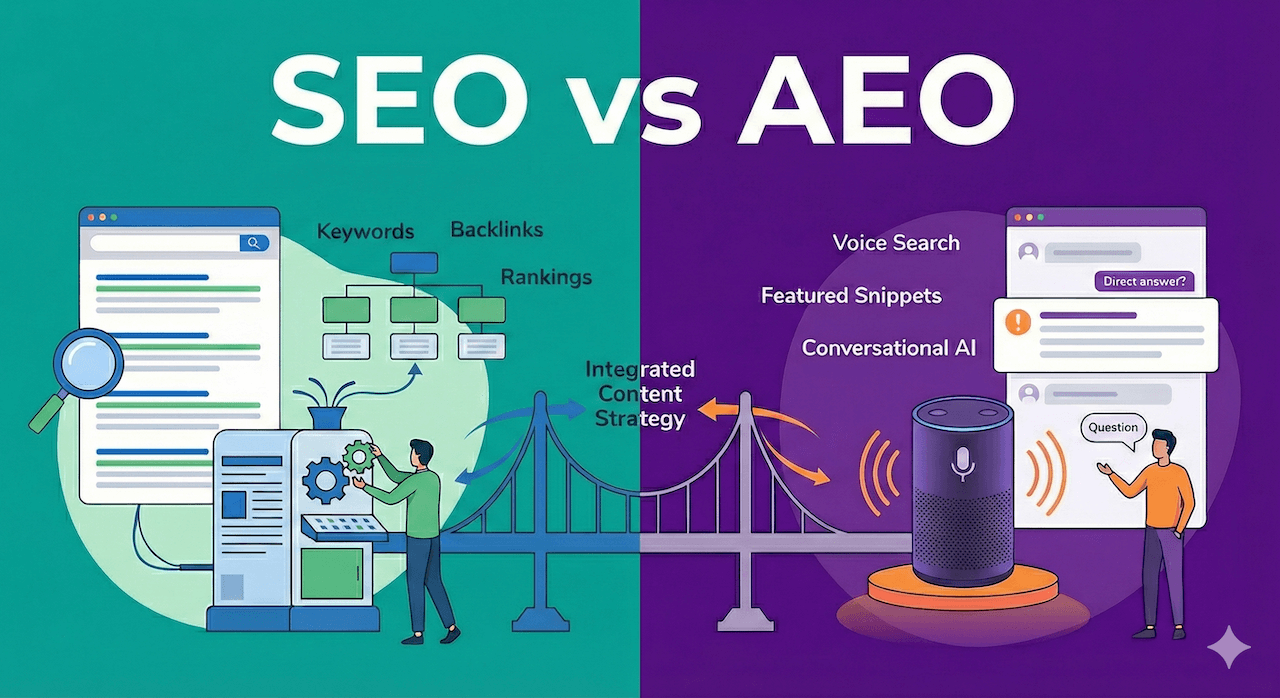
The businesses thriving in 2026 won't be those clinging solely to traditional SEO. They'll be organizations that have integrated SEO, GEO, and reputation management into unified strategies. This integration demands fundamental shifts in how you create content, measure success, and allocate resources.
Content must now demonstrate multi-dimensional authority across web search, voice queries, and AI responses. Successful organizations are implementing structured approaches with budget allocations around traditional SEO, answer-first optimization, and GEO strategy development.
And instead of focusing solely on rankings and click-through rates, new GEO metrics include:
Forward-thinking companies are setting up GA4 tracking for AI referral sources and conducting monthly reviews to analyze content performance in AI responses.
The window for competitive advantage is narrowing rapidly.
Many companies are using generative AI to create content faster and personalize campaigns, while AI-driven processes and the best AI CRMs are accelerating lead qualification and optimizing marketing workflows. So, at the moment, GEO represents more than a buzzword. It's also a strategic necessity for maintaining visibility.
Organizations that combine traditional SEO with new GEO measures can position themselves as trustworthy sources in AI-generated responses and actively influence purchase decisions.

Selling Signals delivers actionable advice for sales and marketing professionals. Learn strategies that help you hit targets, strengthen customer relationships, and win more business. Get expert advice on lead generation, sales processes, CRM software, sales management, and account management directly to your inbox.
Property of TechnologyAdvice. © 2026 TechnologyAdvice. All Rights Reserved
Advertiser Disclosure: Some of the products that appear on this site are from companies from which TechnologyAdvice receives compensation. This compensation may impact how and where products appear on this site including, for example, the order in which they appear. TechnologyAdvice does not include all companies or all types of products available in the marketplace.