Big Teams Lose to Small Ones for a Reason |
During Small Business Week, one theme keeps coming up: Small teams are shipping faster than ever. Projects that used to take months now take weeks, sometimes days. It’s easy to attribute that to better tools, but tools aren’t the real advantage — focus is. |
Small teams move fast because they’re forced to be specific about who they’re targeting, what problem they solve, and what actually matters. Big teams, on the other hand, slow down because they try to accommodate everyone. More segments. More stakeholders. More “just in case” messaging. And that’s where things start to break. When targeting gets broad, speed drops; but more importantly, pipeline quality drops with it. I asked our very own founder and CEO, Rob Bellenfant, for his POV on this. His answer was simple: larger teams don’t just slow down; they lose precision trying to feed a bigger machine. |
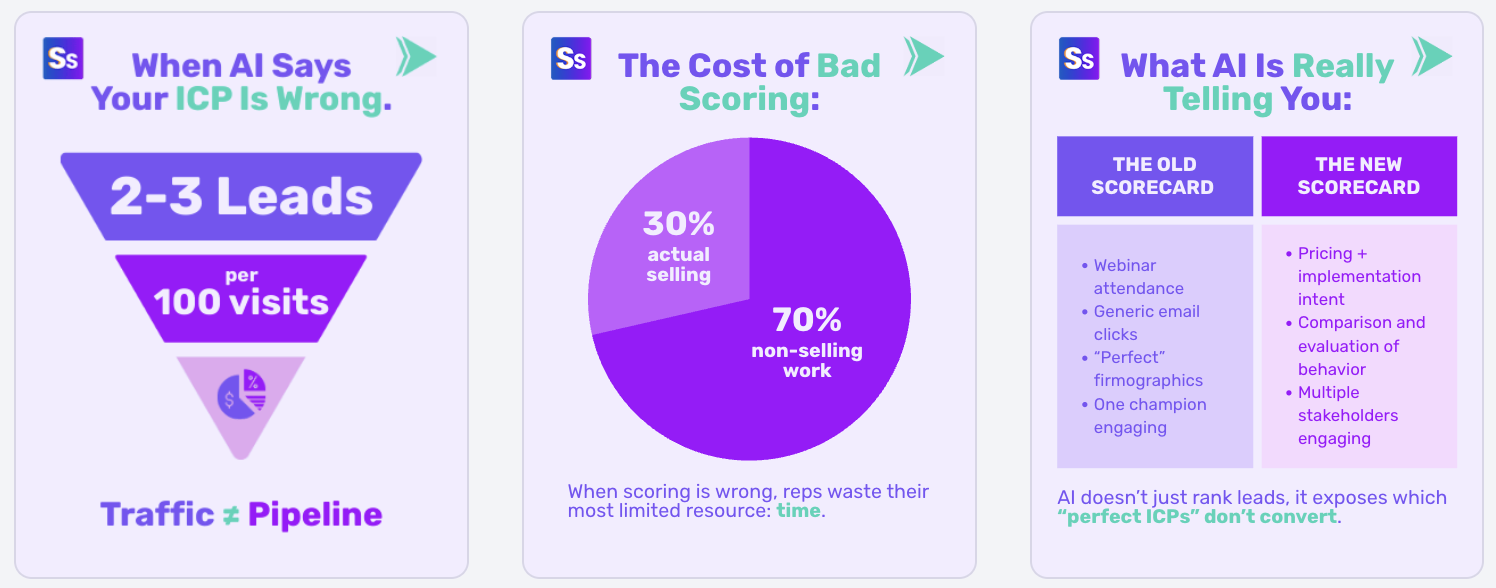
🩺 Diagnosis: Your pipeline isn’t constrained by demand; it’s diluted by who you’re trying to serve. |
|
|
|
Smaller teams don’t just move faster. |
Small teams move faster because they’re focused. They’re forced to decide early who they’re for, what problem they solve, and what doesn’t matter. That constraint sharpens everything: positioning, campaigns, and conversion. Larger teams tend to do the opposite. As targets grow, ICPs expand. New segments get added. Campaigns are built to “cover more ground.” That’s where things start to slow down.
Every added segment introduces more messaging variation, more stakeholders, and more compromise. Execution takes longer — and when it finally ships, the message lands weaker. |
As Rob put it, broadening the ICP to “feed the machine” leads directly to: |
- Generic messaging
- Lower-quality pipeline
- Diluted positioning
|
Example:
A SaaS company defines its ICP as “mid-market companies with 100 to 1,000 employees.” That includes a 120-person startup buying its first system and a 900-person company replacing an existing one with procurement involved. Same ICP on paper, but completely different buyers in reality. Marketing runs one campaign across both. As a result, it takes longer to build, longer to approve. When it finally goes live, it resonates with neither because it’s too broad despite its good messaging. |
Design campaigns around a single buying moment, not a segment. When each campaign is built for a specific situation, like replacing a broken system under time pressure, decisions get faster, messaging gets sharper, and execution speed becomes an advantage — not a bottleneck. |
|
|
|
Submissions have been edited for length & clarity |
|
|
|
| Where do larger GTM teams lose precision that smaller teams are forced to maintain? “They broaden their ICP and loosen qualification to feed the bigger machine. This leads to generic messaging, a lower-quality pipeline, and diluted positioning. Smaller teams are forced to stay sharp and focused out of necessity, which usually drives higher win rates.”
What’s one decision smaller teams make faster that gives them an advantage in the pipeline? “They quickly kill losing experiments and double down on what’s working. Large teams often let underperforming efforts drag on due to politics and sunk costs. That speed in decision-making gives smaller teams a real edge in building a clean, high-quality pipeline.”
- Rob Bellenfant, Founder and CEO at TechnologyAdvice |
|
|
|
That loss of focus doesn’t stay in marketing. |
It shows up immediately in sales, and this is where the speed gap turns into a pipeline problem. When targeting is precise, deals move quickly. Reps recognize the problem, and buyers recognize themselves. |
However, when targeting is broad, everything slows down. Reps aren’t advancing deals. Instead, they’re diagnosing them. |
Example:
A rep follows up after a strong first call with a Head of Ops. The buyer mentioned they’re replacing a broken internal workflow tied to onboarding delays. The rep sends a general case study, a product overview deck, and a “let me know if you want to continue” email. However, there’s neither a mention of onboarding nor a reference to the workflow issue. There’s no response from the buyer, so the deal gets marked as “stalled.” But nothing actually broke. The follow-up just didn’t reflect the problem the buyer was trying to solve. |
This isn’t a follow-up problem; it’s a precision problem upstream.
When your ICP is broad, your sales motion defaults to reusable assets instead of situation-specific ones. Small teams adapt faster because they see the same problems repeatedly. Larger teams standardize to handle volume. That’s where speed breaks down. Not in execution, but in relevance. |
Introduce a “next-step relevance check” after the first call. Before any follow-up is sent, reps should tie it directly to the buyer’s stated problem, trigger, and desired outcome. If the follow-up could be sent to any prospect in your ICP, it’s not specific enough — and it won’t move the deal forward. |
|
|
|
From the dashboard, everything looks fine. |
|
|
|
From the dashboard, everything looks fine: pipeline is up, and lead flow is strong. But conversion rates aren’t improving, and sales cycles are getting longer. That’s the tradeoff most teams don’t see.
Broadening your ICP makes it easier to generate a pipeline, but it also makes that pipeline harder to convert. Marketing sees reach, and sales feels friction, while leadership sees “growth.” But the buyer sees something else entirely: A message that almost fits, but not enough to act on. Smaller teams win not because they move faster, but because they stay precise long enough for that precision to compound. |
|
|
|
Enjoyed this issue?
We break down how buyers actually move and what top teams do differently. If you’re rethinking your funnel or pipeline, catch up with our past issues. |
|
|
|
More ways to connect with Selling Signals! |
Get the latest in sales and marketing without opening your email. Follow us on LinkedIn or Facebook for swipeable frameworks, bite-sized visual breakdowns, and a chance to join the conversation. |
|
|
|
|
Bianca has spent the past four years helping businesses strengthen relationships and boost performance through strategic sales and customer engagement initiatives. Drawing on her experience in field sales and territory management, she transforms real-world expertise into actionable insights that drive growth and foster lasting client partnerships. |
|
| |
Selling Signals is a TechnologyAdvice business © 2026 TechnologyAdvice, LLC. All rights reserved.
TechnologyAdvice, 3343 Perimeter Hill Dr., Suite 215, Nashville, TN 37211, USA. |
|
|
|
|