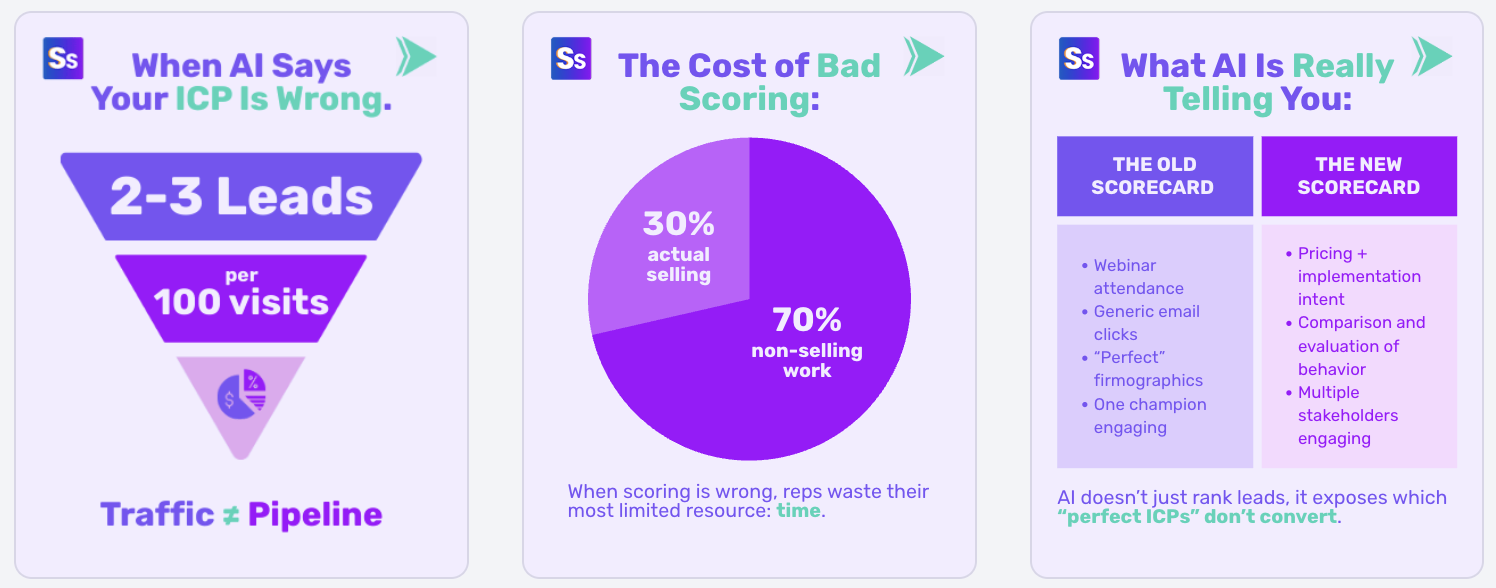
Thursday Brief: Your pipeline is being shaped outside your system |
In our last sends, we covered how small teams win when they move with focus, and how most ICPs are too broad to be operationally useful. This week’s signals push that argument further. Gartner says marketing budgets remain flat at 7.7% of revenue even as GTM complexity rises. Adobe is reframing B2B orchestration around real-time signals and AI-guided engagement instead of static funnel stages. New research shows 73% of B2B buyers now use AI tools during purchase research, while most marketing teams still lack visibility into how they appear inside those systems. These signals point to one truth: GTM is shifting from funnel management to signal interpretation. That changes the competitive advantage.
The best GTM teams will not be the ones generating the most activity. They will be the ones that can detect buyer movement earlier, narrow faster, and adapt in real time while everyone else is still waiting for visible intent. In other words, the future belongs to teams with sharper systems, not bigger motions. |
|
|
|
Where is your GTM system still pretending the buyer waits for you? |
|
|
|
When marketing is measured on revenue, budget reviews become audits. The strongest defense isn’t louder dashboards; it’s revenue data that’s consistent, explainable, and trusted across the business. 👉 Visit CaliberMind |
|
|
|
#1: Buyer discovery is leaving your funnel |
🔎 If you’re not in the answer, you’re not in the deal.
Averi’s analysis finds that 73% of B2B buyers now use AI tools like ChatGPT and Perplexity for purchase research, while only 22% of marketers track AI visibility. That is not an SEO story. It is a pipeline formation story.
Buyers are forming shortlists inside answer engines before your attribution model sees anything. Your content may still rank. Your brand may still be known. But if AI systems cannot interpret, trust, and cite your positioning, you may never enter the consideration set. |
🎯 Why this matters for GTM leaders
Marketing no longer owns the first touch. It owns the evidence layer that machines and buyers use before the first touch point. 🛠️ What to do |
-
Audit whether AI tools describe your category the way you do.
- Rewrite ICP pages around buying situations, not persona labels.
- Build comparison content that answers tradeoffs directly.
- Track citations, not just rankings.
- Treat third-party proof as infrastructure, not decoration.
|
#2: Platforms are turning GTM into signal orchestration |
🎛️ Your stack is becoming a decision engine, not a workflow engine.
Adobe’s push toward “B2B 3.0” and agentic CX systems signals a deeper shift in enterprise GTM design: platforms are moving away from lead management and toward continuous signal interpretation. Adobe’s framing is explicit — future GTM systems will “listen for signals from accounts in real time and let AI guide the next best conversation.”
That sounds like a product evolution. It’s actually an operating model change. |
For years, GTM systems were built around stages: MQLs, handoffs, funnel progression, and lifecycle routing. But buyers no longer move linearly enough for those systems to work cleanly. The emerging model is different:
Persistent signals. Continuous prioritization. Dynamic orchestration.
The implication is uncomfortable: most companies still organize GTM around static fields while buyers behave like moving targets. 🎯 Why this matters for RevOps and GTM leaders The advantage is no longer having more data. It’s having systems that know which signals matter right now.
Teams with slower interpretation layers will look busy while missing active demand. 🛠️ What to do |
-
Replace static lead scoring with behavioral change detection.
- Rebuild routing logic around “buying movement,” not form fills.
- Create ICP tiers based on in-market behavior, not just fit.
- Audit which GTM workflows assume linear buyer journeys.
- Measure signal response time as a core RevOps KPI.
|
#3: Budget pressure is forcing system discipline |
💸 Flat budgets punish vague GTM.
Gartner analysis finds marketing budgets remain flat at 7.7% of company revenue, even as CMOs face expanding strategic demands. Meanwhile, 6sense’s 2026 BDR report says performance increasingly depends on AI adoption and support systems, not just rep effort.
This is where the previous sends connect. Small teams win because they cannot afford vague motion. Narrow ICPs work because they force tradeoffs. Flat budgets make both unavoidable. The teams that win will not be the ones with the most campaigns, but those with the cleanest operating logic. |
🎯 Why this matters for founders, CMOs, and CROs Efficiency is no longer a Finance mandate; it is a GTM design constraint. 🛠️ What to do |
-
Cut segments that cannot produce repeatable evidence of intent.
- Reallocate budget from broad reach to signal capture and interpretation.
- Measure pipeline by account movement, not campaign volume.
- Build smaller plays for sharper markets.
- Stop asking “Did this generate leads?” Ask “Did this improve timing?”
|
The old GTM model assumed buyers entered your system early.
The new reality: buyers are shaping decisions before your system sees them. That breaks broad targeting, linear funnels, and volume-first execution.
More activity won’t fix delayed understanding. What matters now is signal precision.
Smaller surfaces. Faster interpretation. Sharper orchestration. The winners won’t be the teams doing the most.
They’ll be the teams built to notice what others miss first. |
|
|
|
Enjoyed this issue?
We break down how buyers actually move and what top teams do differently. If you’re rethinking your funnel or pipeline, catch up with our past issues. |
|
|
|
More ways to connect with Selling Signals! |
Get the latest in sales and marketing without opening your email. Follow us on LinkedIn or Facebook for swipeable frameworks, bite-sized visual breakdowns, and a chance to join the conversation. |
|
|
|
|
Bianca has spent the past four years helping businesses strengthen relationships and boost performance through strategic sales and customer engagement initiatives. Drawing on her experience in field sales and territory management, she transforms real-world expertise into actionable insights that drive growth and foster lasting client partnerships. |
|
| |
Selling Signals is a TechnologyAdvice business © 2026 TechnologyAdvice, LLC. All rights reserved.
TechnologyAdvice, 3343 Perimeter Hill Dr., Suite 215, Nashville, TN 37211, USA. |
|
|
|
|