Your ICP Is Too Broad to Be Useful |
“Fits our ICP” has become the easiest way to justify the pipeline. The company looks right, the title matches, and the industry checks out. So, the lead moves forward. But “fit” doesn’t mean the buyer has a real problem, a reason to act, or even a clear understanding of why they’re talking to you; it just means they could buy.
During Small Business Week, there’s a lot of focus on how smaller teams do more with less. What gets overlooked is the fact that they don’t have the luxury of vague targeting. When every lead counts, “fit” isn’t enough. It has to be right, and right now. |
Patrick Dillon, CRO at Nudge Security, framed it in the simplest possible way: |
“If you can’t point to what’s happening that makes now the right time, you’ve defined a market, not a buyer.” |
🩺 Diagnosis: Your ICP defines who qualifies, not who converts. |
|
|
|
Most ICPs are built on firmographics. |
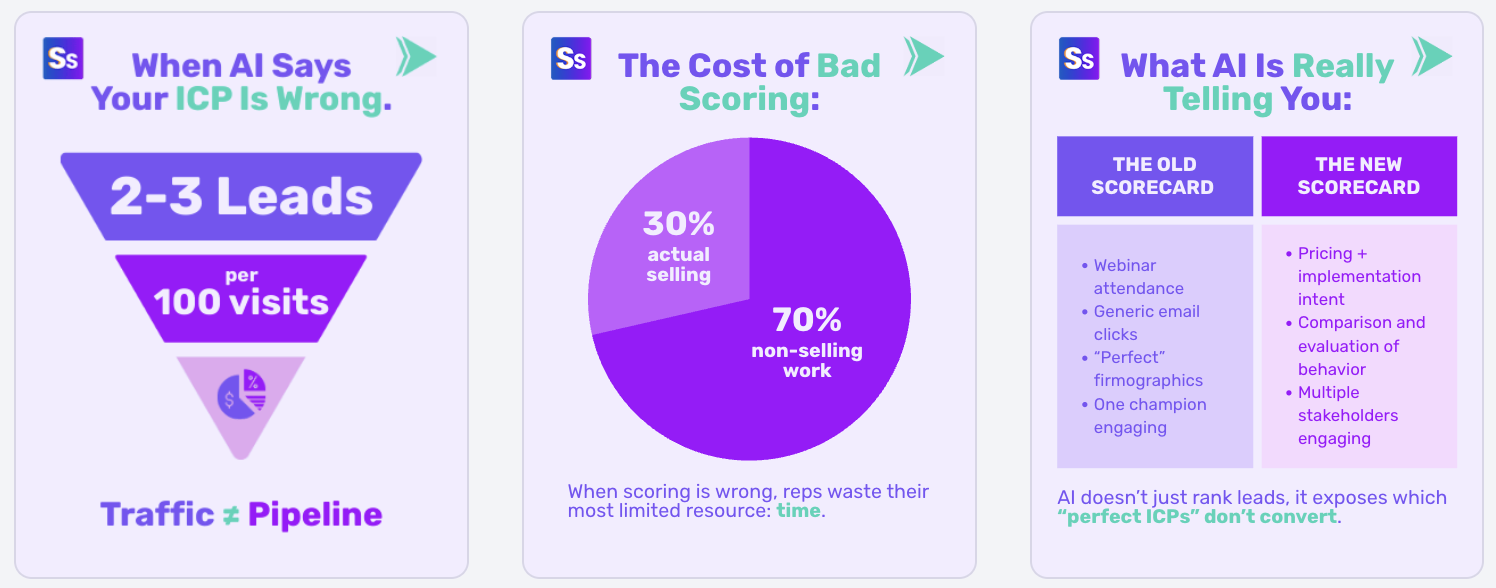
Industry. Company size. Revenue range. They are clean, easy to segment, and easy to report on. But none of those explain why a buyer is in the market. And that’s where things break. Two companies can look identical on paper and behave completely differently in the pipeline. |
Example:
Two 300-person SaaS companies enter your funnel. One is replacing a broken tool after a failed rollout, while the other is “exploring options” for next year’s roadmap. Same ICP and campaign, but only one is actually a buyer. But both get the same messaging. That’s the problem: you’re targeting static traits, while buying is driven by dynamic context.
Michael Maximoff, Co-founder at Belkins, saw the same issue when they tightened their targeting: |
“We cut about 70% of accounts that technically fit our ICP but weren’t a real match, and engagement went up.” |
Bill Flynn, CEO of Catalyst Growth Advisors, puts it more bluntly: |
“If two companies look the same in your ICP but behave differently in the pipeline, you’re probably sorting companies, not buyers.” |
Anchor your ICP to buying triggers, not just attributes. Instead of targeting “mid-market SaaS,” define segments by situations like post-failure replacement, rapid scaling, or compliance pressure. These are the conditions that create urgency and actually drive the pipeline. |
|
|
|
Submissions have been edited for length & clarity |
|
|
|
|
What’s the clearest signal that an ICP is too broad to drive real pipeline decisions? “You usually see it in the pipeline. You’ll have two deals that look the same on paper — same size, same industry — but one moves and the other just… doesn’t. That’s when you realize your ICP is describing companies, not what’s actually going on inside them.” How should teams redefine the ICP around buying context rather than firmographics? “If you want to fix it, don’t start with the profile. Go back and look at your last handful of wins and the ones you thought you had but lost. What was actually happening in the business when those deals started?
That’s where the pattern is. It’s seldom size or industry; it’s the situation they were in.” - Bill Flynn, CEO at Catalyst Growth Advisors |
|
|
|
Sales feels this immediately. |
Because once a lead enters the pipeline, the expectation is movement. But if the buyer isn’t actually in a buying situation, there’s nothing to move. So, reps compensate by asking more questions, extending the discovery, and trying to create urgency where none exists. Example:
A rep takes a call with a Head of Marketing who fits the ICP perfectly. It’s a great company with the right size and in the right industry. However, halfway through the conversation, it becomes clear there’s no active initiative, no defined problem, and no timeline. The call goes well, but it doesn’t go anywhere. Still, the deal gets logged, and follow-ups are sent. Eventually, it just… stops.
No clear “no.” No clear next step. Just silence. |
That’s the signal. You didn’t lose the deal because there was no deal to begin with. Andy Springer, Director of Sales Training at RAIN Group, sees this pattern constantly: |
“You’re qualifying for fit, not for whether there’s actually a reason to act.” |
|
|
|
Introduce a “buying signal check” before a lead becomes an opportunity. Reps should confirm a triggering event, a defined problem, and a reason to act now. If those aren’t present, keep the lead in nurture instead of forcing it into the pipeline. |
|
| |
Lead quality looks fine, the pipeline volume is healthy, and activity is high. However, close rates don’t improve because the issue isn’t who you’re targeting; it’s when you’re targeting them.
Broad ICPs make it easier to fill the pipeline, but they also make it harder to move it. Marketing sees qualified leads, and sales sees stalled deals, while leadership sees growth. But the system isn’t selective. Without selectivity, the pipeline becomes a holding area rather than a signal of demand. |
What to change this week: |
🎯 Add buying triggers to your ICP definition.
Identify events like tool replacement, hiring spikes, or process breakdowns that indicate real demand, not just eligibility. 🧠 Separate active buyers from passive ones in your pipeline.
Tag leads based on urgency and intent so sales can focus on deals that can actually move. 🚫 Make timing a required qualification criterion.
A lead shouldn’t become an opportunity unless there’s a clear reason to act now. Not every good fit is a real opportunity, and treating them like one is what slows everything down. |
|
|
|
Enjoyed this issue?
We break down how buyers actually move and what top teams do differently. If you’re rethinking your funnel or pipeline, catch up with our past issues. |
|
|
|
More ways to connect with Selling Signals! |
Get the latest in sales and marketing without opening your email. Follow us on LinkedIn or Facebook for swipeable frameworks, bite-sized visual breakdowns, and a chance to join the conversation. |
|
|
|
|
Bianca has spent the past four years helping businesses strengthen relationships and boost performance through strategic sales and customer engagement initiatives. Drawing on her experience in field sales and territory management, she transforms real-world expertise into actionable insights that drive growth and foster lasting client partnerships. |
|
| |
Selling Signals is a TechnologyAdvice business © 2026 TechnologyAdvice, LLC. All rights reserved.
TechnologyAdvice, 3343 Perimeter Hill Dr., Suite 215, Nashville, TN 37211, USA. |
|
|
|
|