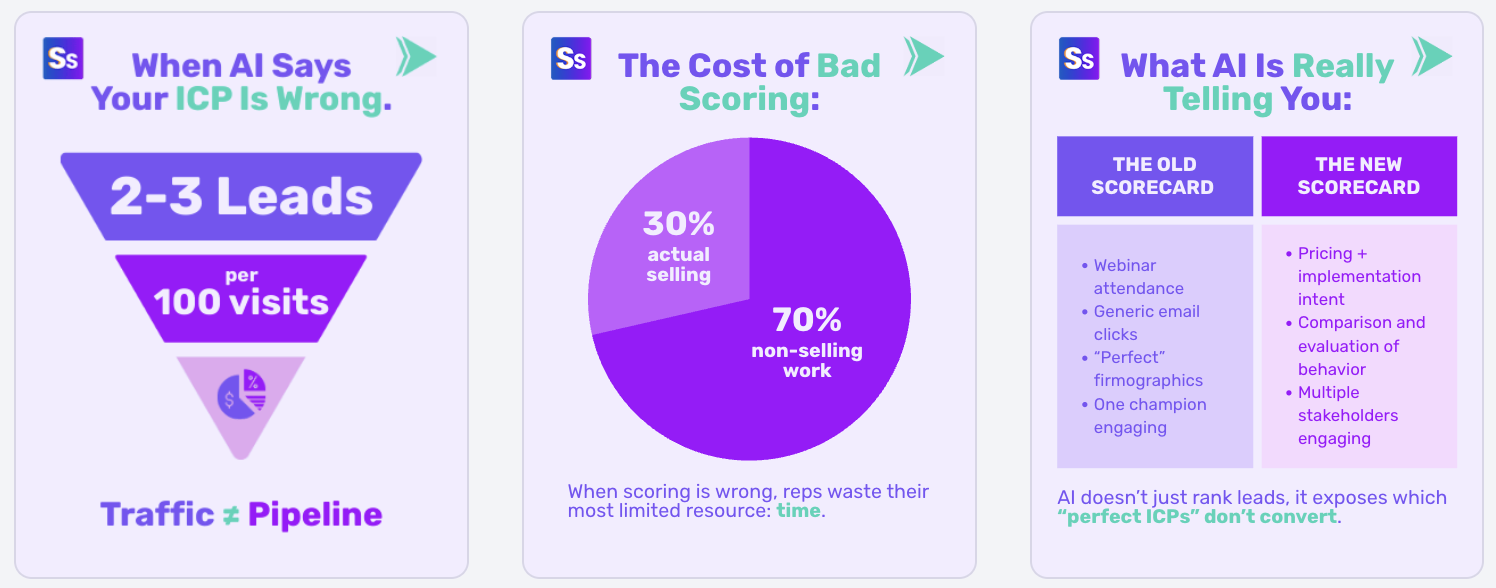
Congratulations on the Webinar Attendance. The Buyer Still Isn’t Buying. |
Today is World Metrology Day — the global celebration of measurement. This day raises an uncomfortable question for revenue teams: What exactly are we measuring in the pipeline? |
Most teams are not really measuring buyer progress, just the things around it. These include the meetings booked, emails opened, demos completed, stages advanced, and opportunities created. All of these are useful, but none are complete.
A deal can move from Stage 2 to Stage 4 without the buyer making a single meaningful internal decision. And yet, the dashboard still looks healthy — but that’s the trap. Teams measure what’s easiest to track, not buyer progress, which is the hardest to prove. As Leslie Venetz, founder of The Sales-Led GTM Agency, put it: |
“Sales activity metrics create the most false confidence because they tell you what the seller did, not whether the activity actually moved the deal forward.” |
🩺 Diagnosis: Pipeline activity is measurable. Buyer commitment is harder — and that’s exactly why most teams avoid measuring it. |
|
|
|
The one-size-fits-all GTM era is over. Attio built something for what comes next. |
AI has closed the gap between an idea and a working motion. The teams winning now aren't following a template. They have a point of view, and the freedom to act on it faster than anyone else. GTM Atlas is a free resource from Attio, written by operators at Lovable, Clay, and Vercel. Real frameworks and systems thinking for teams building their own motion, from lead capture to expansion. Mapped by operators. Curated by Attio.
|
|
|
|
Marketing teams often mistake engagement for intent. |
A target account downloads a report, attends a webinar, and revisits the pricing page. Suddenly, the account is treated as if the pipeline is warming up. Maybe. Or maybe one evaluator is researching options six months before a budget conversation even exists. That’s the problem with activity-based measurement. It creates the appearance of momentum without proving buying movement. Haider Alleg, General Partner at Allegory Capital, warned against exactly this kind of context-free measurement: |
“One of the vanity metrics people love is visibility, followers, or even just revenues without context.” |
Example:
A marketing dashboard shows higher webinar attendance, stronger email engagement, more traffic to the pricing page, and increased MQL volume. Everyone celebrates, which is reasonable because we all enjoy a graph going up. But sales is still hearing: |
“We’re just exploring options.”
“This isn’t a priority yet.”
“Maybe next quarter.” |
The metrics improved, but the buyer commitment didn’t.
The strongest marketing teams separate curiosity from progression. They look for signs that engagement is becoming a real buying process: more people from the account engaging, decision-makers showing up, urgency increasing, and implementation questions starting to appear. |
Real pipeline progression usually creates friction inside the buyer organization, not just clicks inside your dashboard. |
🎯 Recommendation: Add a “progression signal” layer to your marketing reporting. Don’t just track whether an account engaged; track whether engagement expanded, deepened, or moved closer to a buying decision. |
|
|
|
Help shape future TechRepublic coverage by taking our quick 5-minute audience survey. Share your insights on technology trends, purchasing decisions, and the content that matters most — plus enter for a chance to win a gift card. Access here |
|
|
|
Submissions have been edited for length & clarity |
|
|
|
|
Which commonly used pipeline metric creates the most false confidence? “Sales activity metrics create the most false confidence because they tell you what the seller did, not whether the activity actually moved the deal forward.
Sales will always be a numbers game, but numbers without conversion don’t create revenue; they create noise and, eventually, reputational damage. Teams get overly focused on metrics like emails sent or cold calls made without measuring whether those activities convert into qualified opportunities or meaningful buyer engagement. I frequently remind clients and peers that more is not a strategy.”
What metric or signal better reflects whether a deal is actually moving forward? “To determine whether a deal is actually progressing, I look at buyer-initiated activity.
For example, instead of tracking how many discovery meetings were completed, I look at how many ended with a mutually agreed-upon next step where the buyer accepted the calendar invite and committed to moving the process forward.
Sales organizations often focus on the activity they can see on a CRM dashboard, but the clearest signal that a deal is real is buyer participation: Are they replying quickly? Bringing in stakeholders? Following through on next steps? Actively engaging in the buying process? That’s the difference between seller activity and actual deal progression.”
- Leslie Venetz, B2B Expert and Founder at The Sales-Led GTM Agency |
|
|
|
Sales teams fall into the same trap. |
Instead of measuring engagement activity, they measure stage movement. A deal advances because the demo happened, the proposal was sent, the meeting went well, or the buyer “seemed interested.” But none of those prove the deal is actually progressing. Example:
A rep moves an opportunity into the late-stage pipeline because the buyer requested pricing. Sounds reasonable, except procurement hasn’t been involved, legal hasn’t reviewed anything, no executive stakeholder has engaged, no implementation discussion has started, and no timeline has been confirmed. The deal moved stages, but the buyer didn’t move decisions. That’s how measurement starts drifting away from reality. |
“To determine whether a deal is actually progressing, I look at buyer-initiated activity.” |
She gave a simple example: instead of tracking how many discovery meetings happened, track how many ended with a mutually agreed-upon next step that the buyer actively committed to. That’s a very different signal. Lolita Trachtengerts of Spotlight.ai made the distinction even sharper: |
“Stage and activity tell you what the rep did. Engagement, sentiment, and stakeholder movement tell you what the buyer is doing.” |
A serious buyer leaves measurable signals behind: stakeholder expansion, internal alignment, timeline pressure, procurement involvement, operational planning, or legal review. That’s progress.
Not just: “The call felt positive.” And definitely not: “We had a great demo.” |
|
|
|
Redefine stage progression around buyer-side actions, not seller-side activities. If the buyer hasn’t materially advanced the decision internally, the deal probably hasn’t advanced either. |
|
|
|
Revenue teams naturally gravitate toward metrics that are easy to track. |
|
|
|
More outreach, meetings, engagement, and stage progression. The dashboard moves, so everyone assumes the business is moving, too. But measurement systems shape behavior. And most pipeline systems reward visibility, not buyer advancement.
So, naturally, reps optimize for stage movement, and marketers optimize for engagement spikes. Leaders optimize for cleaner dashboards, and everyone quietly learns how to manufacture the appearance of momentum. |
That’s how teams end up celebrating: |
- Demos without urgency
- Engagement without commitment
-
Pipeline without progression
|
The measurement system trained them to. But the healthiest GTM teams understand something most organizations miss: People optimize for whatever gets measured. So, if your pipeline metrics reward activity more than buyer commitment, don’t be surprised when the pipeline fills up with activity instead of actual buying movement. |
|
|
|
Enjoyed this issue?
We break down how buyers actually move and what top teams do differently. If you’re rethinking your funnel or pipeline, catch up with our past issues. |
|
|
|
More ways to connect with Selling Signals! |
Get the latest in sales and marketing without opening your email. Follow us on LinkedIn or Facebook for swipeable frameworks, bite-sized visual breakdowns, and a chance to join the conversation. |
|
|
|
|
Bianca has spent the past four years helping businesses strengthen relationships and boost performance through strategic sales and customer engagement initiatives. Drawing on her experience in field sales and territory management, she transforms real-world expertise into actionable insights that drive growth and foster lasting client partnerships. |
|
| |
Selling Signals is a TechnologyAdvice business © 2026 TechnologyAdvice, LLC. All rights reserved.
TechnologyAdvice, 3343 Perimeter Hill Dr., Suite 215, Nashville, TN 37211, USA. |
|
|
|
|