






Forecasting revenue is essential for B2B teams. With longer sales cycles, multiple buyer interactions, and changing market conditions, sales and marketing professionals need structured tools to predict outcomes, coordinate teams, and reassure leadership. That’s where a sales forecast template comes in handy.
In this guide, you’ll get:
- A download link for the full B2B Sales Forecasting Template Bundle
- A walk-through on creating a forecast tailored for B2B sales and marketing teams
- A deeper insight into the benefits of using forecasting templates and team-specific use cases
Regardless of your role — VP of Sales, RevOps leader, or marketing director — these projected sales forecast templates will provide you with actionable insights to implement each year.
- Download the free B2B sales forecasting template bundle
- Unpacking the 5 sales forecast templates for B2B teams
- Step-by-step guide: How to create a sales forecast for B2B teams
- B2B sales forecast template examples & use cases
- Benefits of using sales forecasting templates
- Frequently asked questions (FAQs)
- Bottom line
Download the free B2B sales forecasting template bundle
According to Xactly’s 2024 Sales Forecasting Benchmark Report, 98% of sales leaders struggle to build accurate forecasts, and 90% say better tools would dramatically improve forecasting accuracy and detail. In other words, most teams don’t have the structured systems or models needed to forecast confidently.
To help solve this, I created a B2B Sales Forecasting Template Bundle designed specifically for sales, marketing, and RevOps teams that need a clear, reliable way to project revenue throughout the year.
Each template works on its own, but the real value comes from using them together to produce a holistic forecast across leads, pipeline, accounts, and marketing channels.
This bundle includes:
- Lead-based forecasting model built for B2B (volume → conversion → ACV → revenue)
- Weighted-pipeline model for opportunities already in motion
- Account-based sales forecast model for target accounts and ABM programs
- Quarterly and annual forecasting sheets with dashboard visualizations
- Marketing-to-sales attribution forecast model by channel and touchpoint
These templates are built in Google Sheets, but you can use them in Excel or any spreadsheet tool. Just make a copy (File → Make a Copy) and customize it to match your team, your goals, and your 2026 revenue targets.
Once you’ve downloaded the bundle, continue reading this guide to learn exactly how to use each of the five templates in your B2B forecasting process.
Unpacking the 5 sales forecast templates for B2B teams
Before diving into the step-by-step forecasting process, it’s helpful to understand what each template in the bundle is designed to do.
The five templates below cover every major forecasting angle, including leads, pipeline, accounts, time periods, and marketing attribution, so you can build a complete and accurate view of expected revenue for the year.
| Template | Why B2B teams need it | Best for |
| A. B2B lead-based sales forecast template | • Shows a direct connection between marketing qualified leads (MQLs) and sales revenue • Helps teams plan content, campaigns, and SDR outreach • Ideal “top-of-funnel to revenue” visualization | • Marketing-led teams • Demand generation • Sales development reps (SDRs) |
| B. Weighted pipeline forecast template | • Provides a realistic weighted revenue forecast • Helps sales leaders evaluate quarter-end attainment • Useful for long or complex B2B sales cycles | • Sales teams with active pipelines • Account executives • SDRs • RevOps |
| C. Account-based sales forecast template | • Forecasts revenue from high-value accounts • Helps ABM teams align marketing and sales plays • Ideal for enterprise teams with fewer, larger deals | • Account-based management (ABM) teams • Enterprise sales • Account executives |
| D. Quarterly revenue forecast template | • Applies to board-level discussions and strategic planning • Offers a macro view across the year • Helps teams set quarterly pipeline targets | • Leadership reporting • Board decks • RevOps planning |
| E. Marketing-to-sales attribution forecast template | • Helps marketing teams forecast revenue impact by channel • Supports cross-functional planning and budget allocation • Useful for omnichannel campaigns | • Marketing teams working on full-funnel forecasting |
A. B2B lead-based sales forecast template
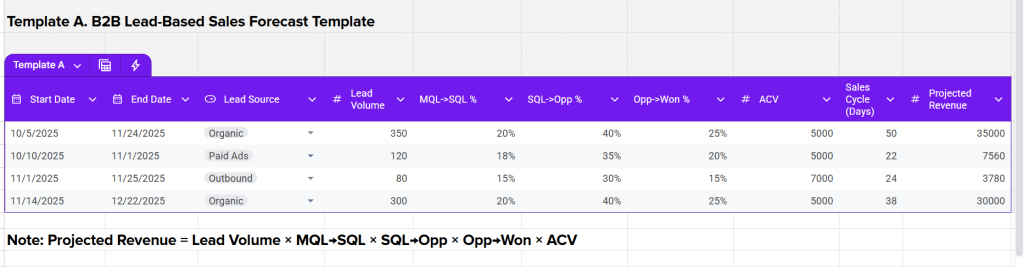
This template helps B2B teams estimate future revenue by connecting lead volume to sales outcomes. Simply enter your expected leads per channel, conversion rates, sales cycle length, and average contract value (ACV).
The template automatically projects monthly and quarterly revenue totals. This makes it ideal for demand-gen-driven organizations where marketing contributes a significant portion of the pipeline.
Primary use: Top-of-funnel → revenue forecasting
B. B2B weighted pipeline forecast template
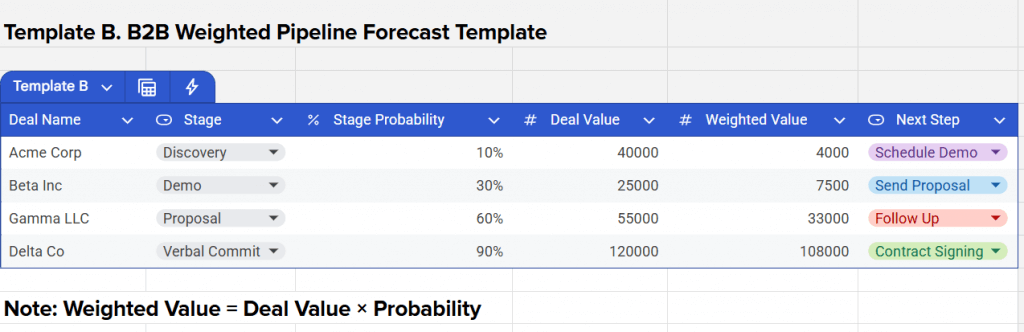
Perfect for sales teams managing active pipelines, this template calculates weighted revenue based on opportunity stage probabilities. Just input deal values and stage, and the sheet automatically generates weighted revenue projections.
This model is beneficial for long B2B cycles, where forecasting confidence increases as deals progress through the pipeline.
Primary use: Stage-based forecasting for active opportunities
C. B2B account-based sales forecast template
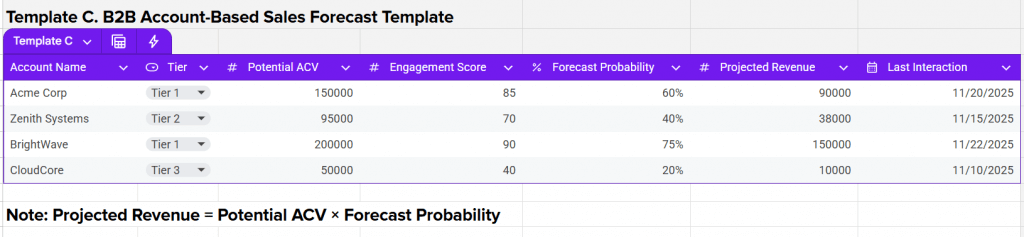
Built for ABM and enterprise teams, this template organizes revenue projections by account. You can customize the template by assigning account tiers, tracking engagement scores, setting forecast probabilities, and calculating potential ACV. It’s perfect for organizations focused on landing fewer, higher-value accounts.
Primary use: Account-level revenue projections
D. B2B quarterly revenue forecast template
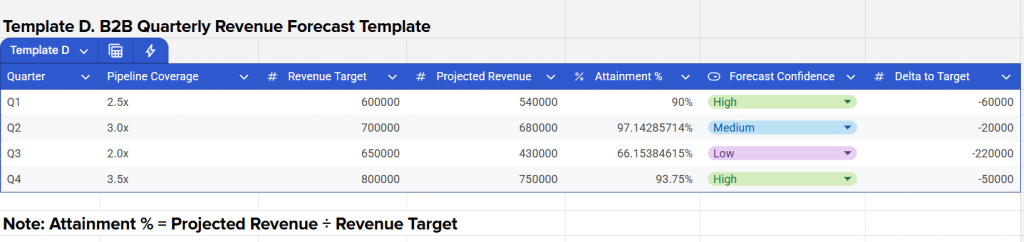
This high-level forecasting template provides a leadership-friendly view of quarterly revenue expectations.
It includes fields for pipeline coverage, revenue targets, attainment percentages, stage progression, and forecast confidence levels. It’s also excellent for board decks and quarterly business reviews.
Primary use: Strategic quarterly planning and reporting
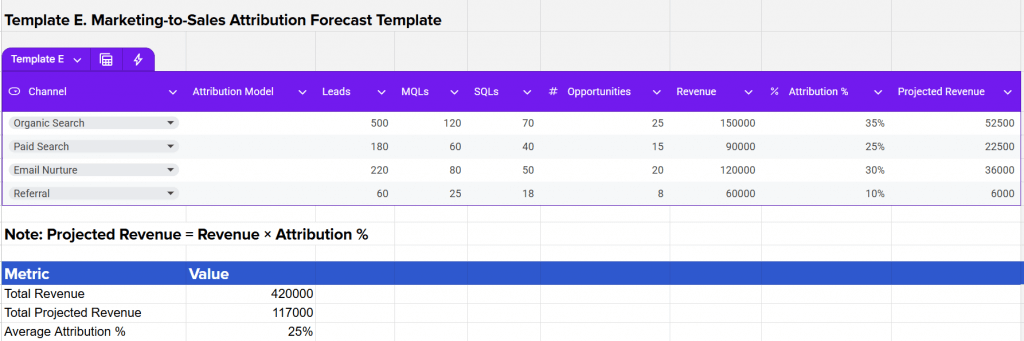
E. Marketing-to-sales attribution forecast template
This template forecasts revenue by channel using attribution models like first-touch, last-touch, and multi-touch.
By linking leads, MQLs, SQLs, opportunities, and revenue to specific channels, B2B teams can identify which marketing initiatives drive the pipeline most and predict future output more accurately.
Primary use: Channel-specific revenue forecasting based on attribution
Step-by-step guide: How to create a sales forecast for B2B teams
Once you have downloaded your sales forecast template bundle, use the five templates together to build a complete, multi-layered B2B revenue forecast.
Each template covers a different part of the sales engine, shifting from lead generation to pipeline health, account strategy, and marketing attribution. So, I broke down the instructions for each template to give you a full, accurate view of projected revenue for 2026.
Step 1: Start with the lead-based forecasting model (top-of-funnel projection)
Template used: Lead-based forecasting model built for B2B
- Enter projected lead volume by source: Add monthly or quarterly lead targets for each channel (organic, paid, outbound, events, etc.).
- Enter your known or target conversion rates: Include MQL → SQL, SQL → Opportunity, and Opportunity → Won.
- Enter your average contract value (ACV): Use a single ACV or multiple ACVs by product or segment.
- Review the model’s projected revenue output: The template automatically calculates projected revenue from each source based on the assumptions you entered.
- Confirm your volume targets are realistic: If the forecast is too high or low, adjust lead volume or conversion benchmarks.
Step 2: Add the weighted-pipeline model (bottom-up projection)
Template used: Weighted-pipeline model for opportunities already in motion
- Add all current opportunities: Include deal name, stage, projected close date, and deal value.
- Select the applicable stage probability: Choose from your predefined stage weights (Discovery, Demo, Proposal, etc.). Also, feel free to add your own stages when customizing your template.
- Review the weighted revenue the template calculates: The sheet instantly shows “realistic revenue” based on the deal stage.
- Check your pipeline coverage: Compare weighted revenue vs your quarterly targets.
- Identify stage bottlenecks: If most deals sit in early stages, adjust expectations accordingly.
Step 3: Layer in account-based forecasting (strategic revenue outlook)
Template used: Account-based sales forecast model for target accounts and ABM programs
- List your target accounts by tier: Use the dropdown to add Tier 1, Tier 2, and Tier 3 accounts or your ABM segments.
- Tier 1: High-value, high-fit accounts with strong engagement signals and higher forecast probabilities.
- Tier 2: Mid-value accounts with solid potential and moderate engagement that may convert with consistent outreach.
- Tier 3: Lower-value or early-stage accounts that require more nurturing and typically carry lower forecast probability.
- Input potential ACV for each account: Use historical ACV, firmographic fit, or your internal estimates to fill in this column.
- Add engagement or intent scores: Higher engagement often indicates a higher likelihood of progression, so make sure to monitor these numbers.
- Assign a forecast probability: Select the probability based on tier and engagement.
- Review the template’s projected revenue output: The sheet auto-calculates projected revenue per account and per tier so you can track your revenue projections over time.
Step 4: Build executive-level visibility with quarterly and annual summary dashboards
Template used: Quarterly and yearly forecasting sheets and dashboard visualizations
- Pull in forecast numbers from the three templates above:
- Lead-based forecast
- Weighted-pipeline forecast
- ABM/account-based forecast
- Check your quarterly revenue outlook for the following
- Forecast vs target: Compare your projected revenue against quarterly goals to see whether you’re on track, ahead, or behind. Highlight any gaps early so sales and marketing can realign their activities before the quarter closes.
- Pipeline coverage: Review how much pipeline you have relative to your target (e.g., 3x or 4x). Low coverage may signal the need for additional top-of-funnel campaigns, more outbound activity, or accelerated deal movement.
- Attainment percentages: Track your attainment percentage throughout the quarter to monitor your pace toward hitting revenue targets. Sudden drops may indicate slowed deal velocity or stalled opportunities that need intervention.
- Review annual summaries
- Look at how quarterly performance rolls up to your year-end projection. Identify:
- Which quarters are over- or underperforming
- Seasonal fluctuations or predictable slow periods
- Whether marketing or pipeline improvements are needed to close year-end gaps
- This view helps you make proactive decisions, instead of reacting to missed targets at the end of the year.
- Look at how quarterly performance rolls up to your year-end projection. Identify:
- Use dashboards for leadership reviews
- Visual dashboards make it easier for leaders to understand the forecast at a glance. Include charts that show:
- Quarter-over-quarter revenue trends
- Pipeline aging and stage distribution
- Gaps between best-case and committed forecast
- High-risk vs high-confidence deals
- These visuals help you communicate performance more clearly, uncover risk earlier, and secure alignment across sales, marketing, and RevOps.
- Visual dashboards make it easier for leaders to understand the forecast at a glance. Include charts that show:
Step 5: Build monthly and quarterly forecasts
Template used: Marketing-to-sales attribution forecast model by channel and touchpoint
- Choose your active marketing channels from the dropdown
- Organic, paid search, paid social, email, webinars, events, partners, etc.
- Choose an attribution model from the dropdown
- First-touch, last-touch, multi-touch, or time decay.
- Enter your lead, MQL, SQL, and opportunity data
- The template aligns these with revenue for each channel.
- Review the auto-generated projected revenue per channel
- The sheet calculates revenue contribution based on the attribution model.
- Compare channel revenue to your top-of-funnel forecast. This tells you:
- Which channels actually drive revenue
- Which lead sources produce the most valuable pipeline
- Where to increase or reduce spend
Step 6: Finalize, align, and update your forecast
Once all templates are in place:
- Cross-check projections across all models
- Ensure the lead-based, pipeline, ABM, and attribution forecasts tell a consistent story.
- Review with sales, marketing, and RevOps
- Validate assumptions and adjust targets where needed.
- Lock your committed and best-case projections
- Committed: Weighted pipeline + conservative assumptions
- Best-case: Lead-based + ABM upside
- Update the templates regularly
- Pipeline and ABM: Weekly
- Lead-based and attribution: Monthly
- Dashboards: End of month or quarter
B2B sales forecast template examples & use cases
To effectively use a B2B sales forecast template, it’s crucial to tailor it to your specific business context.
Below are a few scenarios that illustrate how different organizations can adapt this forecasting tool to meet their specific needs.
Marketing-led demand generation teams can use the lead-based forecasting template to connect top-of-funnel activity directly to revenue.
By entering projected lead volume, channel-specific conversion rates, and ACV, these teams can quickly see how marketing efforts influence pipeline creation and quarterly revenue targets. This helps organizations refine campaign strategies, allocate budget more effectively, and adjust their funnel targets based on performance trends.
Enterprise outbound organizations benefit most from the weighted-pipeline forecasting model.
By evaluating opportunities based on stage probability, reps and leaders gain a realistic view of expected revenue and can better identify where deals are stalling.
This supports more accurate quarter-end forecasting, clearer prioritization of high-value accounts, and improved resource alignment across longer sales cycles.
Hybrid product-led growth (PLG) and sales-led teams typically manage multiple customer segments with different ACVs, sales motions, and conversion rates. By duplicating the template for each segment, such as PLG, SMB, mid-market, and enterprise, teams can track segment-specific performance and forecast revenue more accurately.
Consolidating these segment views into a single dashboard provides a complete picture of growth drivers across the business, helping leaders optimize resources and tailor strategies for each segment.
Benefits of using sales forecasting templates
While there are many benefits to using a sales forecast template, the following list includes an overview of why the templates above are most beneficial for B2B sales and marketing professionals.
- Improved revenue predictability: With consistent inputs and a structured approach, a sales forecast template enhances the reliability of your revenue predictions and reduces last-minute surprises.
- Stronger alignment between sales and marketing: Templates standardize terminology (MQL, SQL, ACV), ensuring marketing and sales are aligned on what the “pipeline” looks like and how it converts to revenue.
- Faster reporting and leadership communication: Pre-built templates reduce manual effort and errors, making it easier to present forecasts to leadership, board members, and cross-functional teams.
- Optimized budgeting and resource planning: When you can project revenue confidently, you can also plan campaign investment, tech stack spend, and operational capacity more strategically.
- Clear visibility into performance trends: Templates let you pinpoint where things are going off track (e.g., lead volume shortfall, conversion rate drop), so you can take corrective action before it’s too late.
Frequently asked questions (FAQs)
How do I choose the right sales forecast template for my B2B team?
Choose a sales forecast template based on your sales cycle, data availability, and forecasting model. B2B teams often benefit most from templates that track lead stages, conversion rates, and projected revenue across long sales cycles.
How often should B2B teams update their sales forecast?
Most B2B teams update their sales forecast template weekly or monthly to reflect new pipeline activity, closed deals, and shifting market conditions.
Should marketing contribute to sales forecasting?
Yes. Marketing should contribute to sales forecasting because their data, including lead volume, lead quality, campaign performance, and conversion rates, directly affects revenue projections. When marketing aligns with sales, the sales forecast template becomes more accurate and reflects the full demand-generation pipeline.
Bottom line
In 2026 and beyond, B2B teams that rely on guesswork will fall behind those who forecast with data, structure, and alignment.
By downloading the B2B Sales Forecast Template Bundle, customizing the lead-sales projection format, and following the step-by-step walk-through above, you’ll give your team the tools to project revenue confidently, drive cross-team alignment, and respond quickly to shifts in pipeline dynamics.
Ready to get started? Download the pack, adapt the template, and make 2026 your most predictable year yet.
